Enterprise Initiatives

This blog focuses on Enterprise IT topics such as Enterprise Architecture, Portfolio Management, Change Management, Business Process Management, and recaps various technology events and news.


Showing posts with label Wine. Show all posts


I have many colleagues and friends who have been through messy divorces. In each case, these poor guys have gone from having the good life, to having issues, to losing half of their assets (or more). I just filed my divorce papers for Microsoft's Vista. In my case, my relationship with Vista never went through the good life period. I gave up half of my assets to "live" with Vista (memory, CPU, performance, costs). But when I split up with Vista, I got it all back!

With all jokes aside, I recently posted my positive experience of installing Kubuntu on an old 1.7GHz machine that was taking 10 minutes to boot up XP. The registry was beyond repair and the various programs like Spybot, Adaware, PitStop, Defrag, and many others did little to improve performance. The desktop was destined for the dumpster. Enter Kubuntu and this PC now works like a champ. I installed Wine on it and got IE 6.0 running on it for those foolish websites that target only the Microsoft browser. My daughter plays various Flash enabled games on Club Penguin. On my brand new Dell Inspiron 1721 laptop running Vista, these games take almost a minute to launch. On my old clunker PC w/only 256MB of Ram it loads in about 3 -5 seconds. That got me thinking.....how would this site perform on my new laptop under Linux?

So I installed Mepis 64 bit on my laptop and wiped out Vista. My daughter launched her game and it loaded instantly. Her exact words were, "Wow, this is so fast". My response was "Good Bye Vista!". So let's take the religion out of this discussion and talk about the investment I just made on my hardware. I bought two brand new identical laptops for $1000 each. These laptops have a Dual-core 64 bit processor with a Gig of memory. Now the Microsoft fanatics would cry, "why would you buy a laptop with only a Gig of memory?" My answer is, my budget doesn't allow for laptops that cost $2K-$3K and the main usage of these laptops are web browsing, email, and word processing. None of those functions require a ton of computer resources. I also have a monster machine (Dell XPS gaming machine) for all of our intense gaming needs (Battlefield 2, Civilization IV, Age of Empires, etc.). So two laptops for $2000 dollars was what I was willing to spend. Unfortunately, Dell did not offer XP or Linux on these machines. The cost of Vista is about $300. So 30% of the cost of my laptops was for an operating system that drained 50% of my resources and performed poorly.

I am not a financial analyst, but that is not a good spend of money. Now that I have eliminated Vista from the equation, I get a better ROI on my investment, even after acknowledging that I threw away $300 worth of software. As I mentioned in a post called Vista - What were they thinking, my wife dislikes Vista so much that she refuses to use the new laptop that I bought her for her birthday (due to it's poor performance). Now she is happy with the laptop running Mepis and the old clunker running Kubuntu.

My plan now is to move all of our computers except the gaming machine to Linux. The gaming machine will stay on XP while the laptops will leverage Wine and virtual machines for those Windows centric programs that won't run on Linux. I will install various Linux distributions and allow for the user to select from a list of distributions when booting the system. Eventually we will probably settle on a distribution like Kubuntu of Freespire that has an interface similar to Windows for an easy transition.
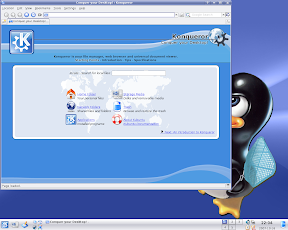

From Kubuntu

So for all of the folks out there who have gone through a messy divorce, divorcing your Vista operating system is the only divorce in town where you get your assets back and still get to keep your kids!




A few weeks ago I posted a few articles about Open Source (Still afraid of Open Source?, Eating my own dog food, and Open Source and loving it!). I have now been Microsoft-Free at work for about 7 weeks. I have also found solutions for almost all of the initial hurdles I encountered in the first week. Here is the list:

  1. Email - I now have Thunderbird working flawlessly as my email client in sync with Exchange. I do need to talk to the Exchange admin to change a setting on the Exchange Server so I can use the Calendar functionality with Sunbird. I am currently use Webmail for my calendar.
  2. Office - Open Office has worked well with Word, Power Point, Excel, and Adobe documents. I can use Wine to install Visio on my Ubuntu desktop. This doesn't allow me to be totally Microsoft-Free but there is no answer for Visio's proprietary format that I am aware of. This is not an issue with Open Source, the problem is that Microsoft doesn't use an open standard for their Visio product. Open Office Draw works fine for creating new drawings but can't import Visio documents saved in Visio format. I also downloaded OxygenOffice Professional that gives me the much needed templates and clip art that Open Office was missing.
  3. Browser - I have been using Firefox at work for years so this a no brainer.
  4. Printer - I do have one unresolved issue. I have an old HP Laserjet (about 8 years old). Although I can see the driver I can't get the printer to work. I have not invested a ton of time trying to fix it.
Before all of the Microsoft defenders start slamming me, let me put my disclaimers out. My goal of this article is to prove that people can be productive at work without the need of Microsoft software. I am not saying that because I can be productive that everyone should abandon Microsoft and start a project to implement Linux corporate wide. However, I do recommend to those who are open to exploring alternatives that they should start a small pilot project with a handful of desktop users. I think a 5-10 person pilot with Ubuntu or Mepis would be a great way to learn about the opportunities and challenges that an Open Source OS presents. This is low risk and high return. A pilot like this will give your IT shop an opportunity to try out alternatives without disrupting the day to day business.

When I first started my experiment I was trying to keep it a secret out of fear of attacks from angry Microsoft worshipers (especially from the admins and desktop support). What I am finding out is that most of the folks that I was hiding from are sick and tired of supporting Windows and are proponents of Linux. Several of them are using Linux at home. One of the guys I talked to has Vista and XP installed on his laptop. He swaps out the hard drive when switching between OS's. He is less then impressed with Vista and complains about the slow boot time (2 times slower then XP). I recently moved to a new office and a desktop guy saw my Ubuntu desktop when I was moving. I expected an ear full but instead the guy said he fully supports a move to Ubuntu and wished the company would move in that direction. These stories are coming from Microsoft certified engineers who have spent years supporting Microsoft tools. These stories are not coming from anti-Microsoft people who worship Linux.

There is one myth I would like to discuss. I keep hearing how difficult it is to install Linux. I have two comments about this:
  1. I found the Ubuntu install to be quite simple. Maybe some of the older versions of Linux where cumbersome but the recent versions are very straightforward.
  2. If an organization chooses to go with Linux on the desktop, trained professionals will be responsible for installing Linux. This is how Windows gets installed today. People tend to accept that fact that Windows is a simple install because they receive their desktops or laptops already configured. Is the Windows install really all that much easier then the Linux install or is it the fact that most people never have to bother installing Windows?
Once again, these are my observations. I have been using Windows for years. I don't hate Windows, although I am not a fan of Microsoft as a company. I do give Microsoft credit for creating a product that has changed computing forever. For companies with huge budgets it might make sense to continue down the Microsoft path. For small and medium sized companies with limited budgets, startups, and educational or government funded operations, I believe they should consider exploring alternatives. The worst thing that can happen with a small pilot is that you discover that Linux won't work for your organization. At least then you can sleep at night knowing you did your homework and made a strategic decision based on real information. One word of caution, though. If you take on a pilot, make sure you have a few people on the team who are not married to Windows or Linux. Get some folks with an open mind who are interested in the overall good of the company and are not married to a certain technology.


Subscribe to: Posts (Atom)

My favorite sayings

"If you don't know where you're going, any road will get you there"

"Before you build a better mouse trap, make sure you have some mice"