There is so much confusion (and fear) about what the term Cloud Computing means and what it really is. Now that everybody kind of "gets" SOA, the new buzzword that people can't grasp is Cloud Computing. Everyday I see the same questions being asked in LinkedIn like What is the difference between Cloud Computing and SaaS? A simple question like this will get 100 different answers. So this is my attempt to clear the fog on Cloud Computing in a simple non-technical way (sorry for boring those that already know this stuff).
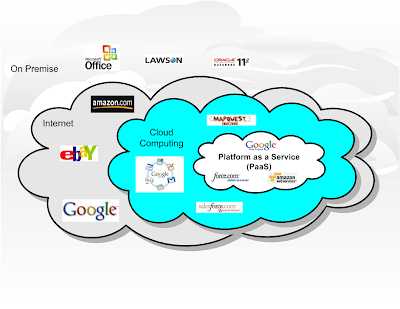
Here is a picture that shows a high level view of different types of cloud computing
This picture is very basic but shows different types of companies leveraging the cloud model. You can also see that some types of computing are a subset of the cloud. Let's talk about the different types and what they represent (forgive me as I reuse some slides from a previous presentation).
First you have the Internet which we are all familiar with. When the Internet first became the buzz, a lot of the same confusion and fears that surround cloud computing today were being discussed back then. How is it secure? Who owns the infrastructure? How do I control it? Early adapters saw the opportunity to reduce costs by moving brick and mortar operations to the Internet and increase revenue by providing services and goods 24x7x365. This following picture shows some major web sites that leveraged the Internet (or should I say Cloud 1.0 to be hip).
Then came Software as a Service which was pioneered by companies like Google and SalesForce.com. With SaaS, instead of buying shrink wrapped software that you must install on your infrastructure, patch, administer, and do all of those other non-value added tasks, you simply "lease" the rights to use the services that are provided. In the case of Google and services like GMail, you get it for free.
Companies like Google, SalesForce.com, and Amazon have built out huge datacenters in multiple locations with an enormous amount of capacity. They cannot afford to have a huge spike of traffic take their sites down and risk losing millions of dollars a day. At some point, these companies realized that they could offer their excess capacity for a fee to other companies to use. These companies would be able to take advantage of world class production environments that are proven to withstand millions of concurrent users. This is what is known as Platform as a Service (PaaS) and Infrastructure as a Service (IaaS). The difference is the platform.
PaaS providers like Google's App Engine and Force.com allow you to build your own applications on top of virtual server instances but restrict you to using their development languages. For Google it is Python, for Microsoft's Azure it is .Net, for Force.com it is Appexchange. One could argue whether Facebook should be classified as PaaS. I put it there because they now provide a full development platform for running applications on Facebook. Checkout this Facebook App by Starbuck's.
Infrastructure as a Service (IaaS) removes this limitation and gives you the ability to create virtual servers and develop in whatever you choose. The most popular IaaS vendor is Amazon who is in my opinion the leader in innovation and maturity in the cloud computing space.
So when people ask me what cloud computing is, I include all of these different models into my definition. "In the Cloud" to me means leveraging infrastructure off-premise. With SaaS solutions, the underlying infrastructure is hidden from you. With PaaS, you manage the amount of virtual server instances you use but you must use the technologies required by the provider. With IaaS, you manage the resources you use and are free to leverage whatever technologies you choose to deploy on.
Here are a few other useful resources that show a fairly complete list of vendors and the niche they fill.
Peter Laird - Visual map of cloud computing
Markus Klem - Cloud Classification diagrams
John Willis - Tools to use in the Cloud
John lists a number of vendors who provide a wide variety of tools to manage, configure, monitor, and scale including open source alternatives.
Check these resources out. I hope this gives you all a clear picture of what Cloud Computing is. The benefits and the risks are blog topics within themselves. I'll save that for another day!
I have been blogging for quite some time about SOA and Event Processing and have recently been getting more experience with Cloud Computing. The last few weeks I did a series of posts on agile SOA:
- Agile SOA: Empower the Business with Business Rules Engines
- Agile SOA: The Flexibility of Business Processes
- Agile SOA: Leveraging Data Services
- Enterprise Mashups: The Icing on your SOA
- Must integrate with multiple customers, suppliers, partners
- Must be configurable
- Data may physically be stored in different locations for different customers
- We don't own or want to own a data center
- We want our customers/partners to be able to extend our services
- We will deliver our software as a service
- Each customer/partner has unique business processes and rules
- We need to deliver our content on many different mediums and devices
 I have spent a lot of time recently questioning the leadership of IT organizations who become a cost center due to a "keeping the lights on" mentality and have asked the question Are we Sleeping at the Wheel?. The other day I stumbled across a great article (thanks to some of my pals from Twitter land) that really hits the nail on the head. This is a must read article that brings to light what I think is the main reason why many IT leaders are missing the boat on emerging technology trends. The article is written by Steve Andriole is called Managing IT: Changing Our Minds (About Everything) and discusses how IT leaders who have been around a while have to let go of solutions of the past and totally change the way they think. Here are a few excerpts...
Here’s the deal. The world has changed – forever. First, hierarchical management structures will weaken as we continue to globally decentralize our business units. We have to change the way we think about control, standardization and the overall governance we bring to technology acquisition, deployment and support.
Here is his thoughts on Open Source which I have been championing for quite some time...
Open source is here to stay. Even the established vendors have “embraced” open standards. They have no choice. Do you?
And what about cloud computing?
We need to change how we think about cloud computing from an incremental shift in technology offerings to a whole new way of acquiring, delivering and supporting digital technology
Here is my favorite...
Debating endlessly about whether or not open software, cloud computing or SaaS have any merit is a waste of time – and most likely a diversionary tactic designed to slow – if not outright kill – the pace of change.
Please take the time to read the entire article. I think the message is an important one. If you are an IT leader who is missing the boat, you need to reevaluate your positions on the emerging technologies and solutions. If you don't you are damning your organization to more years of fire fighting and being a bottleneck to the progress of the business. Don't miss the boat!
 For those of you who have been reading my blog for the last two years, you might know that after 13 years at my previous job I left the company this summer to pursue multiple opportunities that were available to me. I have been doing some consulting and freelance writing in the mean time but have finally found my new gig. I will be the CTO/Chief Architect for a startup (more details forthcoming in the future) and will have the opportunity to work on some of the newer technology initiatives. So here are some of the future blog topics that I will start covering in 2009 once I get rolling:
- SOA - can't seem to let it go! As I wrote in a post at CIO.com, I believe SOA is not just for legacy systems and can be the foundation that startups can leverage as a competitive advantage (see the reasons why)
- Cloud Computing - Startups typically have low budgets and leveraging platform (PaaS) and/or Infrastructure as a Service (IaaS) can be a great way to both minimize costs and reduce time to market. As I go through the requirements analysis, risk analysis, vendor analysis, proof of concepts, prototypes, and deal with issues such as stability and privacy, I will share my lessons learned here.
- Open Source - We will likely leverage many open source solutions and I will discuss those experiences and decision points here.
- Social Software - The company is based in the North East and I live in Florida. It is highly possible that the team I build will be dispersed all over the country and possibly even the world. There will be great lessons learned discussions as well as evaluations of tools to help enable working remotely (virtual whiteboards, live meetings, SaaS solutions for defect tracking, etc.).
- Agile - One of our goals is to deliver quickly and at low cost. This involves a lot of the above mentioned topics and will also lead us into the world of Agile Development. I will discuss our challenges and lessons learned in this area as well.
- C-Level IT topics - In my new role I will be working side by side with other C-Level people within the company as well as with C-Level people of partner and customer companies. I will have to hit the road and sell and/or promote our products/services and will try to shed some light on some of the interesting topics I come across.
- Misc - Other topics that might be worthy of discussing (examples: impacts of financial crisis, VC funding, selling technology to business people and customers, etc.)
- SOA Governance by Todd Biske
- SOA Cookbook by Michael Havey
And finally, I am open to covering any topic that any of my readers would like me to discuss whether it is on this blog, over the phone, or in person. Whenever I travel I send a Tweet on Twitter to let people know where I can be found. I will be in Pittsburgh from Saturday 10/25 through Monday 10/27 if anybody lives there and would like to meet. Don't bug me from 4:15-7:15pm on Sunday because I'll be at Heinz Field pulling for my Giants against a tough Steeler team. The rest of next week I am at the EDM Summit in Orlando.
I look forward to sharing these topics with you all. Over the next two months my focus will be on the business plan and creating a team. We officially launch the company in the December-January time frame. At that point expect to see more discussions on the topics I mentioned above.

Startups and Non-profits
Startups and non-profit organizations typically are constrained by limited capital budgets. Startups need to quickly launch their products and services at low costs. Cloud computing allows startups to rapidly deploy into a “leased” infrastructure supplied by a cloud computing vendor without having to procure a ton of hardware, hire system administrators, and build out a data center. In addition, the cloud computing option allows startups to pay as they grow as opposed to having to pay for maximum capacity out of the gates. Startups also have the luxury of starting with a blank sheet of paper as opposed to having to migrate their legacy applications to the cloud.
Many non-profits, like the United Way and Goodwill, are funded by donations. It is in everyone’s best interest that the majority of these donations are used to benefit the people who need help from these organizations. Building large data centers and hiring people to look over them is not a great way to achieve this goal. Instead, non-profits can now move their data centers to the clouds and spend more of its donated funds on worthy causes instead of infrastructure.
Small and Midsize Companies
Small and midsize companies have to stretch modest IT budgets to meet the demands of the business while providing 24x7x365 capable systems. Some of these companies cannot afford to support multiple data centers to protect against disasters and to provide business continuity. Others have a robust main datacenter and a scaled down backup datacenter that would allow the company to limp along for a short period of time if an unfortunate event was to occur. But the bigger challenge is to focus enough resources on revenue generation. The more resources these companies have keeping the lights on, the less demand from the business they can support. These companies often have to make some compromises in technology upgrades, architectural decisions, and infrastructure purchases to allow them to meet the needs of the business. I have worked in a few midsize companies over the years and witnessed this first hand. Every year we were asked to do more with less money and we often had to provide “good enough” solutions because we could not afford to build the level of robustness into the infrastructure and applications that we would have liked.
With cloud computing, small and midsize companies immediately get the benefits of world class infrastructure without having to procure, implement, and administer it. This frees up resources to focus on innovation and business demands. In addition, these companies can leverage multiple datacenters located in different geographical locations to meet their disaster recovery and business continuity needs. As the demand for computing resources increase, staff can add additional servers and disk on the fly by using tools provider by the cloud computing vendor without having to purchase any hardware. They simply just tap into some more computing resources into the cloud and pay for what they use.
Large Companies
Large companies with billion dollar IT budgets do not have a lot of the issues that the startups, non profits, small and midsize companies have. Many of these companies are watching from the sidelines as cloud computing matures, but still think it is too risky to jump in. The large companies that do adopt cloud computing will be gaining competitive advantages over their competition. Here are some of the reasons why.
Going green – Many billion dollar companies are under intense pressure to be more environment friendly. Replacing thousands of servers and other equipment is an extremely expensive and time consuming undertaking. Large companies can start by migrating their non-mission critical applications to the cloud. This allows them to go green quicker, cheaper, and get a chance to “kick the tires” on cloud computing at low risk.
Reduce costs – Energy costs for running hardware and cooling can be greatly reduced by moving applications to the cloud. In addition to reducing the amount of hardware to buy, this could prevent or at least prolong plans to acquire additional floor space, buy additional generators, or install more cooling systems.
Agility – Prototyping is another opportunity for using cloud computing. The business wants things faster from IT. IT can now quickly create a prototype by leveraging virtual infrastructure in the cloud and experiment with various configurations without having to go through long procurement cycles. Cloud computing can also be used to set up and tear down multiple test areas with ease and without having to free up or buy and configure hardware.
Security/Privacy - Large companies’ biggest fear is security and privacy. That is why some cloud computing vendors offer private clouds for their customers. Companies can enjoy all of the benefits of cloud computing within their own private VLAN and configurable firewalls to protect their data and privacy.
Conclusion
Regardless of the size of a company and its IT budget, cloud computing provides many benefits that just cannot be ignored any longer. For startups, non-profits, and small and midsize companies, cloud computing is a no brainer. Large corporations are being cautious right now. It will only take a few key success stories from a competitor who drastically reduces costs and improves its speed to market to get more large companies on board. In the mean time, large companies should look at piloting a non mission critical application in the cloud and continue to monitor the vendors as cloud computing continues to mature.

I wrote a post a week ago about lessons learned from the Dot-Com bust. In the 1990's, startups were a dime a dozen and VC money was flowing endlessly. Back then, startups were requiring huge sums of money just to get their infrastructure in place. Many of these companies could not afford the initial funding to build scalability into their infrastructure...a huge risk!
Now it's 2008 and VC money isn't as easy to come by, especially at the enormous amounts we saw in the Dot-Com days. The challenge many startups have is keeping the company small to control costs, but at the same time quickly bringing a product or service to market. These two goals can conflict. One approach is to limit your startup costs in your initial infrastructure build out by outsourcing your infrastructure needs to a PaaS (Platform as a Service) provider. This meets both objectives; control costs and quicker deployment. Let's discuss how.
Control Costs
On the surface, the cost of infrastructure in the cloud may sound very expensive. But let's not get stuck on the "sticker price". Instead, let's talk about total cost of ownership (TCO). If I am running a new startup with the requirements of hosting web based products or services that require 99% uptime, the startup costs are huge. Here is a short list of things I would have to shell out money for:
- Servers
- Routers
- Firewalls
- Software licenses
- Load balancers
- Lease or buy data center floor space
- Business continuity and disaster recovery capabilities
- Data storage devices
- Cooling
- Operations and Systems Administration personnel
- Capital funds for the projects to put all of this infrastructure in place
Quicker to Market
In addition to all of these costs, the time it takes for a new team of people to assemble all of this infrastructure is not minimal. For startups who stick to standards and refrain from using proprietary technology solutions, they can have their infrastructure up and running in the cloud in just a few weeks or even days. The PaaS providers will say hours, but I am including the time it takes the company to validate and tweak the environment accordingly. Here are some of the time killers that can be avoided:
- Long vendor assessment initiatives for the various hardware and software vendors
- Multiple procurement processes for each vendor
- Multiple hardware and software installations
- Recruiting and hiring costs coupled with ongoing payroll costs
- Leasing or purchasing of real estate for datacenter(s)
- Time and costs for telecommunications and security efforts
One thing that I am not saying is that security doesn't matter. It matters more then ever when you outsource your data management. What I am saying is that you don't need to invest the time and money upfront to build out a highly secure infrastructure. Instead, you need to do a thorough vendor evaluation and choose the best provider to meet your infrastructure requirements. Then you have to manage your vendor and ensure that all of your agreed upon SLAs are being met.
Startups better suited for PaaS then established companies
Startups have a huge advantage over companies that have been around a while. It is much easier to start in the clouds then it is to move legacy systems and infrastructure into the clouds. I wrote a post on CIO.com last week about how SOA can get you to the clouds quicker. Startups who can see the benefits of cloud computing should take a service-oriented approach in the development of their products and services. The more abstract and loosely coupled their software is, the more agile and flexible they will become. It will also allow them to switch PaaS providers if they are not getting the level of service or support that they want. Another advantage is it can allow the startup to actually leverage two PaaS providers to eliminate the risk of downtime in case one provider fails. Having this option gives a startup the ability to load balance across PaaS vendors and send the majority of the traffic to the lower cost provider. I haven't seen this done but it is a great opportunity to use leverage on the vendors.
Summary
In summary, startups can reduce their upfront costs of infrastructure and staff by starting in the cloud. Long term (5 to 10 years), PaaS or utility computing will likely be the norm. So get a head start and launch in the clouds today. Focus on your core competency while your competition continues to spend millions to keep the lights on.
 I just finished a research paper on the history of the Dot-Com bust for my MBA studies. By the way, I am finally finished next week after three long years! Also this week, I have been doing extensive research on Cloud Computing, specifically Platform-as-a-Service, SOA, and Social Software. What I have noticed is some striking similarities to the Dot-Com hype of the 90's and the hype that is going on today.
What caused the Dot-Com bubble to burst?
In the early 1990’s, former Vice President Al Gore coined the term “Information Superhighway” and discussed expanding the Internet far beyond its current use. The media ran with this vision and suddenly the world was infatuated with the idea, or should I say fantasy, of creating a $200B eCommerce industry overnight (Krueger, 2007).
Suddenly, startup companies called dot-coms started appearing everywhere. The big problem was that many of these startups did not have a sound business model. Instead, they were betting on brand recognition and market share. They borrowed money from venture capitalists and generated millions from IPOs. Many of the dot-coms had a business model that was not geared towards profit, but towards how much traffic they could generate on their web site. Investors put aside best practices and jumped in head first by throwing tons of cash at these “paper” rich companies. Even worse, many of these companies put aside best practices of business and IT management to be the first one in the marketplace to capture users.
What is happening today?
Just like in the 1990’s, the media is making their living by excessively hyping key technologies like SOA, Cloud Computing, Web 2.0, and many others. Do I believe that these technologies are all difference makers? Yes, they are key technologies just like the Internet and Web 1.0 was in the Dot-Com era. But many of the promises of the Dot-Com era are starting to be realized today. This is a result of the learnings from the early pioneers who dove into the Web head first. The same will hold true for today's hyped technologies. The pioneers will stumble through trial and error and over time these technologies will mature to the point where the masses can take advantage of it at a lower cost.
But history tells us that it takes more then a cool technology to make real money. It also takes a sustainable business model, and a combination of sound business and technology management best practices to execute against the business model.
What has changed?
One of the positive things that came out of the bust was huge advancements in technology. Back then, there were major limitations in bandwidth and web functionality. Since those times, enough fiber optical cable has been laid to circle the world over several 100 times. This has paved the way for greater bandwidth and for new functionality that now makes web browsers capable of creating rich user experiences that are equal to desktop applications. Throw in globalization and the early Dot-Com vision is becoming a reality.
The biggest difference today is the amount of capital it takes to start a Web company. Back in the Dot-Com days, startups were ripping through 10’s to 100’s of millions of VC funding and IPO money. Today, a startup can quickly leverage open source technologies, run their entire infrastructure in the cloud, and leverage a combination of SaaS and mashups to quickly get a product up and running in months. The cost of entry is minimal.
But it’s all still the same
But I still see VCs investing in strange companies with questionable business models. Google the words "Web 2.0 Startups" and you will see a few announcements a week were some bizarre company has just secured Series A or Series B funding. Check this link from last year and some of these companies make me start thinking about the Pets.com sock puppet. The Web is getting so crowded with niche social networking sites (LonelyGirl.Com, NurseLinkup.com, BestPartyEver.com, etc.) but VCs are still buying. I guess investing $3-5M is not that risky to the VC firms, especially when their Dot-Com investments were 10 to 100 times larger.
It’s not the technology
What is getting lost in the sea of hype and madness is that these companies are founded on the technologies of the future. Like it or not, we will be operating primarily in the cloud several years from now. The PC will be irrelevant since there will be no need for local disk and CPU intensive processing by the client. The Client will simply be our window to the Web where everything is virtualized, broken down in functional services, and truly independent of the technology and location from where it is being executed. The problem is, the media and vendors are convincing us that we must do this now or we will fall behind. The challenge will be for IT executives to apply these technologies to solve real business problems, not to feed the pockets of vendors and media types.
References
Krueger, S. (2007). The Rise and Fall of the Dot-Com Bubble (Part 1). Retrieved on August 1, 2008 from http://www.entityarts.net/blog/steve_krueger/08-05-2007/rise_and_fall_dot_com_bubble_part_1
This is a question I have been asking myself lately as I look at trends in technology. There are two major areas that lead me to think that IT shops for non-technology companies (banks, retailers, insurance, manufacturing, etc.) will continue a trend of reducing headcount over the next 5-10 years. The first is cloud computing and specifically, Platform as a Service (PaaS).
 |
| From SOA Slides |
You can see from this diagram I created, PaaS takes cloud computing to the next level. Software as a Service (SaaS) are web based applications hosted at a software providers site. PaaS goes one step further and allows a company to run its infrastructure at an infrastructure provider's site. The leaders in this space are Force.com, Amazon's S3, and Google's App Engine. Currently PaaS is far from being mature as witnessed by the recent outages for each of these vendors. Many companies are starting to go the PaaS route with non mission critical applications. Over the next few years, I expect to see these platforms stabilize which will lead to a large shift in mission critical applications moving to the cloud.
So what does this mean to IT shops where technology is not their core competency? As companies move their infrastructure to the cloud, they shift a lot of the work in the areas of system administration and business continuity/disaster recovery to the provider. There will still have to be somebody within the company who is responsible for those areas but the size of these teams will continue to shrink as more systems move to the cloud. As SaaS applications in the areas of ERP, CRM, financial systems and even non business applications like application servers, BPMS and SOA tools move to the cloud, there will be a decreasing need for third party software administration for patches, upgrades, installations, etc. There will also be less development and more integration. This movement starts to commoditize development which makes outsourcing more prevalent. When I add all of these things up, I start to see a world where IT shops are putting more of an emphasis on business SMEs (subject matter experts), architects, and system integrators and a lot less emphasis on custom development and systems administration and network engineers. Before you go nuts, I am not saying that IT shops won't need these skills. I am saying that they won't need as many people to fulfill these roles.
The second area that leads me to believe that IT shops for non-technology companies will get smaller is all of the advancements in telecommunications and social networking. Bandwidth keeps getting faster and cheaper. Within the next five years, streaming media will not be such a burden on corporate intranets. Add to that the plethora of social software that is available on the web and we will start seeing a huge shift towards a mobilized workforce. It's already happening in large companies like IBM. As companies move more work to remote employees and as software becomes more of a commodity, companies might take the opportunity to fight back against rising health care costs and start outsourcing more of this type of work. That does not mean they are going to offshore everything, but they might use a combination of onshore and offshore outsourcing. I have already run across a company in the Tampa Bay area that has gone down this route. They are a bottling company who retains a very small IT shop made up of senior management, a handful of business SMEs, an architecture team, and a PMO. The IT management team works extremely close with the other executives within the company to participate in planning and strategy. All requests for projects come through this C-Level team for approval and funding. Once a project gets approved, it is put out to bid. All of the maintenance and support is off loaded to other firms as well. There is virtually no internal IT staff beyond management and architecture in this firm. It works well for them. I have not talked with them in a few years but I am sure they are looking at PaaS next.
One thing I am not saying here is that these technologies will eliminate jobs. In fact, I see more jobs being created because embracing technology is allowing companies to gain a competitive advantage on the competition who is slow to change. What I do think will happen is that many IT jobs will shift out of the traditional IT shops and move to outsourcing firms and to PaaS providers. The PaaS providers that survive will have multiple facilities across the world. These facilities will have huge data centers with armies of IT people. They will also invest heavily in innovation initiatives as they try to reduce their dependency on electricity and provide a cheaper, greener, and more reliable platform. The picture below shows a Google data center in Oregon. They are leveraging cheap land in areas with water and wind power so they can generate as much of their own energy as possible.

I know that this post may anger some and cause others to think I have lost my mind. I am simply asking some questions and trying to understand where all of this is heading. I have always been fascinated with the evolution of IT and try to understand trends before I get taken by surprise. I remember trying to grasp what the impact of PCs would be when I was a mainframe developer and I remember trying to figure out how the Internet would change our world forever. I knew both of those technologies would change things but not to the level that they have. I think cloud computing, advancements in telecommunications, and social software will combine to create changes even bigger then anything that we have seen in the past.
The last few years have brought many great advancements in technology and the upcoming years promise to bring more. As companies push to drive the costs of IT down while increasing productivity and output, many large enterprise initiatives have become high priorities. The chart below shows IT's top 10 Management priorities for 2008 (source: CIO Insight): When you look at this list it is obvious that today's IT leaders need to be experts in more than just technology. They need to understand the business and they need to have good people skills. I created the following diagram which I call the leadership triangle. I feel strongly that IT leaders need to excel in all three areas: Business, People, and Technology.
From the business perspective, not only do IT leaders need to know how the business's products and services function, they also need to be able to speak in business terms. This requires MBA type skills in the area of Finance, Economics, and Accounting. When you produce your business case for initiating a large new technology project like SOA, Green initiatives, or ITIL you must be able to describe business benefits in terms of NPV (net present value), IRR (internal rate of return), and payback periods. When dealing with infrastructure projects like disk consolidation, virtualization, and others you should understand the different rules of depreciation, lease options, contract and vendor management. The list goes on.
From the people perspective, the IT leader must be a coach/mentor, great communicator and presenter, skilled in leading through change (organizational change management), a negotiator, a sales person, and a visionary.
From a technology perspective, IT leaders must have at least a high level knowledge of a variety of areas including architecture, security, infrastructure, regulatory/compliance, data, quality assurance, operations, etc.
It is rare to find one person who excels in these three areas. If you find one, good luck keeping them around for a long time because they are highly sought out. Some companies can accomplish this by assembling a strong leadership team that works closely together towards common goals. This requires the leader of this group to be exceptional from the people perspective.
IT must embrace itself for constant change.
The next chart shows IT's top ten technologies for 2008 (Source: CIO Insight): Some of the key IT initiatives that could come from this list are SOA, BPM, Business Intelligence, Master Data Management (MDM), Virtualization, SaaS, ITIL, Portfolio Management, Social Computing, and many others. Each one of these initiatives requires people to change the way they have traditionally worked. Some roles and skills may go away and new ones may be created. Many of these initiatives require very specialized skills and demand more collaboration across different areas of expertise, including business SMEs (subject matter experts).
But the technology is the "easy" part. Getting the business sponsors to own and help drive the initiatives and leading people through change is where IT has a huge skills shortage. Many people in IT don't even acknowledge that these two things are important. I can't count how many articles I have read that claims SOA is a failure and is nothing more then hype. The same is said for enterprise architecture (EA) where recently EA has been called a joke. The joke is that companies try these large enterprise initiatives without relevant business drivers and without having an organizational change management (OCM) plan. Many think by simply having smart technicians, they can get any IT project done.
The future will drive even more change.
Over the next few years, cloud computing will become a key driver for reducing complexity, reducing costs, and improving agility. I recently made a short vlog (video blog) on this topic. Software as a Service (SaaS) and Platform as a Service (PaaS) will cause a major shift in the way we think and work. There will be all kinds of resistance from the infrastructure and security staffers. Moving to a platform in the cloud is a threat to the current roles and responsibilities for these folks. Over time (5-10 years), PaaS will become mainstream and IT shops will likely become smaller and will definitely have a different technical makeup then it has today. People will have to retool and stay current with trends. Software will become a true engineering exercise that requires knowledge of distributed systems, security, data management, and networking. Drag-n-drop n-tier developers will become the Cobol programmers of our next decade. Globalization and social software will radically change the team structures. Project teams will be scattered across the globe. Rising oil prices will lead to more virtual offices. Ten years from now we will look back and laugh at the notion of cramming hundreds of people into cubes. Companies will be able to hire staff from around the globe and won't be restricted to local markets. Users will have the power to assemble their own applications by leveraging mashups and software in the cloud. How will we manage the future?
IT Leaders need to change with the times
So what does this all mean? When you add up all of the things I just mentioned, the role of management has become far more demanding. If your managers are struggling today, how will they survive tomorrow? Just think of the cultural and ethical ramifications of managing a remote team of workers from around the world. IT leadership will be even more demanding then it already is and we already have a shortage of leaders who excel in all three areas of the leadership triangle. So how will we solve this dilemma? Currently, many IT shops just "stay the course" and do not adopt any of these large enterprise initiatives. In the future as cost reduction becomes a matter of survival, many of these initiatives won't be optional.
Unfortunately, I don't know the answer to my own question. There is already a skills shortage in IT across the board. There isn't a shortage of people applying for management and leadership positions, but there sure is a shortage of people who are qualified! Where will the next generation of leaders come from? How many companies will recognize the importance of the leadership triangle? How many more IT projects will fail before somebody does something about this dilemma?
What do you think needs to be done? How will we overcome the Leadership shortage?

There have been a few paradigm shifts in IT over the past 30 years. First was the introduction of the PC which changed computing forever. This moved us from a very structured and controlled mainframe environment to an empowered and chaotic distributed environment. The next big change was the introduction of the Internet in the workplace. This has fueled globalization and lead to more demanding and tech savvy customers. The next big thing is cloud computing, specifically, Platform as a Service (PaaS). Before I go into why I believe this to be true, let me clarify the terms.
On Premise
Traditionally, companies run a majority of their software, both proprietary and 3rd party, within their own data centers. Common software products that you see in corporate data centers are Microsoft Office, relational databases like Oracle, DB2, and Sysbase, and financial systems like Lawson and SAP.
Internet
Internet applications are typically web sites or proprietary applications that are built to run on a browser but are hosted within the walls of your company. Popular websites like eBay, Amazon, and Google are run from within those companies data centers. Many of the web applications that most companies built are run within their data center or by some hosting partner. Let's be clear that hosting is not in the cloud. In a hosting environment you have dedicated infrastructure assigned to your application(s) that is not shared with other companies. When you want to scale up you have to buy/lease more infrastructure and bandwidth.
Cloud Computing
With cloud computing, we are now talking about running software that is written by someone else who also manages the infrastructure. SaaS or software as a service is a prime example of this. Salesforce.com has been a leader in this space with their CRM services. You can pay to use any module and plug that module right into your environment. Mashups and services like GMail, Google Docs, Mapquest, social software like Facebook and Twitter fall into this category. How is this different then regular Internet computing? All of these products/services are open and completely programmable and the underlying infrastructure is nothing that you need to manage.
PaaS
Now comes the game changer! Major Internet presences like Google, Amazon, and Salesforce.com have built a highly reliable and scalable infrastructure platform over the years. Now they are building out excess capacity and selling it to us as a service. Now you can take your on premise and Internet applications and run them on their platform. This is a combination of hosting and SaaS but with scale and sharing. Unlike hosting, every company is sharing the same infrastructure. Now a $100M company runs on the same world class infrastructure that a $10B company runs on. There is no other way for the $100M company to justify the robustness of the infrastructure that they get with PaaS. The pricing model changes things significantly. Instead of licensing you now pay as you go. As your traffic increases, your applications have access to virtually unlimited infrastructure and you scale in real time. Good bye disaster recovery and business continuity initiatives. Your entire business continuity plan becomes running on two PaaS providers in case one goes down.
I put together this 7 minute video blog that goes into more detail for you hardcore folks out there.
So what are the main challenges that Saas needs to overcome?
- IT leaders must be educated
- IT leaders fear of giving up control
- IT leaders fear of security issues with giving up their data
- Maturing PaaS technology
What does this mean to IT?
Nick Carr, in his latest book The Big Switch, discusses his thoughts. I had the opportunity to see his presentation live at the Gartner AADI conference last week. He believes that IT shops will be substantially smaller 5-10 years from now. The reason is simple, the majority of our infrastructure and applications will be run and managed elsewhere. We will spend less time patching, securing, and upgrading and more time innovating. Today, roughly 70% of IT hours are dedicated to keeping the lights on, which leaves very little time for us to meet the business needs. PaaS does not eliminate this work, but it does greatly reduce it.
Startups and smaller companies now have advantages like never before. They can quickly bring a product to market at very low cost and only pay for the traffic that they generate. As they grow and attract customers, the infrastructure scales automatically to meet their needs. Now, they still need to architect their software to scale, but they don't have to worry about bandwidth, adding machines, and dealing with licenses. This means that your biggest competitive threat might be a company that has not started yet. Your existing competitors have all of the baggage of legacy like your company does. It will take them time to move pieces of their infrastructure to this new way of doing things. It's the new kids on the block that can quickly scale and be agile enough to move at the speed of the consumer.
There is a lot more to talk about on this topic but I'll stop for today. Many people just don't understand PaaS enough yet to see where this can go. I will try to continue to discuss what the future holds and what the impacts of these changes will be to IT and the business.
I stumbled across a video blogging website called Seesmic today. I spent several days at the Gartner AADI conference in Orlando this week and created the following video summing up my thoughts about cloud computing and Platform as a Service (PaaS).
In summary, cloud computing and PaaS are emerging technologies that will drastically change IT over the next few years. IT Leaders need to get better at organizational change management or these initiatives will fail.
Please provide me with some feedback. I want to know if this type of content has any value.


