This is a question I have been asking myself lately as I look at trends in technology. There are two major areas that lead me to think that IT shops for non-technology companies (banks, retailers, insurance, manufacturing, etc.) will continue a trend of reducing headcount over the next 5-10 years. The first is cloud computing and specifically, Platform as a Service (PaaS).
 |
| From SOA Slides |
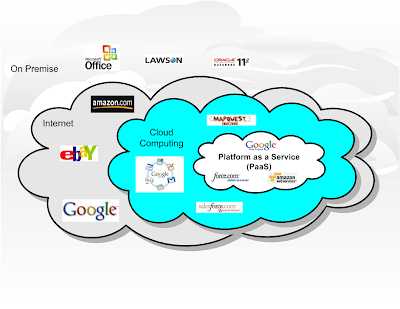
You can see from this diagram I created, PaaS takes cloud computing to the next level. Software as a Service (SaaS) are web based applications hosted at a software providers site. PaaS goes one step further and allows a company to run its infrastructure at an infrastructure provider's site. The leaders in this space are Force.com, Amazon's S3, and Google's App Engine. Currently PaaS is far from being mature as witnessed by the recent outages for each of these vendors. Many companies are starting to go the PaaS route with non mission critical applications. Over the next few years, I expect to see these platforms stabilize which will lead to a large shift in mission critical applications moving to the cloud.
So what does this mean to IT shops where technology is not their core competency? As companies move their infrastructure to the cloud, they shift a lot of the work in the areas of system administration and business continuity/disaster recovery to the provider. There will still have to be somebody within the company who is responsible for those areas but the size of these teams will continue to shrink as more systems move to the cloud. As SaaS applications in the areas of ERP, CRM, financial systems and even non business applications like application servers, BPMS and SOA tools move to the cloud, there will be a decreasing need for third party software administration for patches, upgrades, installations, etc. There will also be less development and more integration. This movement starts to commoditize development which makes outsourcing more prevalent. When I add all of these things up, I start to see a world where IT shops are putting more of an emphasis on business SMEs (subject matter experts), architects, and system integrators and a lot less emphasis on custom development and systems administration and network engineers. Before you go nuts, I am not saying that IT shops won't need these skills. I am saying that they won't need as many people to fulfill these roles.
The second area that leads me to believe that IT shops for non-technology companies will get smaller is all of the advancements in telecommunications and social networking. Bandwidth keeps getting faster and cheaper. Within the next five years, streaming media will not be such a burden on corporate intranets. Add to that the plethora of social software that is available on the web and we will start seeing a huge shift towards a mobilized workforce. It's already happening in large companies like IBM. As companies move more work to remote employees and as software becomes more of a commodity, companies might take the opportunity to fight back against rising health care costs and start outsourcing more of this type of work. That does not mean they are going to offshore everything, but they might use a combination of onshore and offshore outsourcing. I have already run across a company in the Tampa Bay area that has gone down this route. They are a bottling company who retains a very small IT shop made up of senior management, a handful of business SMEs, an architecture team, and a PMO. The IT management team works extremely close with the other executives within the company to participate in planning and strategy. All requests for projects come through this C-Level team for approval and funding. Once a project gets approved, it is put out to bid. All of the maintenance and support is off loaded to other firms as well. There is virtually no internal IT staff beyond management and architecture in this firm. It works well for them. I have not talked with them in a few years but I am sure they are looking at PaaS next.
One thing I am not saying here is that these technologies will eliminate jobs. In fact, I see more jobs being created because embracing technology is allowing companies to gain a competitive advantage on the competition who is slow to change. What I do think will happen is that many IT jobs will shift out of the traditional IT shops and move to outsourcing firms and to PaaS providers. The PaaS providers that survive will have multiple facilities across the world. These facilities will have huge data centers with armies of IT people. They will also invest heavily in innovation initiatives as they try to reduce their dependency on electricity and provide a cheaper, greener, and more reliable platform. The picture below shows a Google data center in Oregon. They are leveraging cheap land in areas with water and wind power so they can generate as much of their own energy as possible.

I know that this post may anger some and cause others to think I have lost my mind. I am simply asking some questions and trying to understand where all of this is heading. I have always been fascinated with the evolution of IT and try to understand trends before I get taken by surprise. I remember trying to grasp what the impact of PCs would be when I was a mainframe developer and I remember trying to figure out how the Internet would change our world forever. I knew both of those technologies would change things but not to the level that they have. I think cloud computing, advancements in telecommunications, and social software will combine to create changes even bigger then anything that we have seen in the past.


