Enterprise Initiatives

This blog focuses on Enterprise IT topics such as Enterprise Architecture, Portfolio Management, Change Management, Business Process Management, and recaps various technology events and news.


Showing posts with label Internet. Show all posts

There have been a few paradigm shifts in IT over the past 30 years. First was the introduction of the PC which changed computing forever. This moved us from a very structured and controlled mainframe environment to an empowered and chaotic distributed environment. The next big change was the introduction of the Internet in the workplace. This has fueled globalization and lead to more demanding and tech savvy customers. The next big thing is cloud computing, specifically, Platform as a Service (PaaS). Before I go into why I believe this to be true, let me clarify the terms.
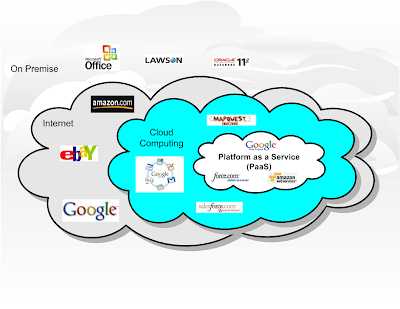


On Premise
Traditionally, companies run a majority of their software, both proprietary and 3rd party, within their own data centers. Common software products that you see in corporate data centers are Microsoft Office, relational databases like Oracle, DB2, and Sysbase, and financial systems like Lawson and SAP.

Internet
Internet applications are typically web sites or proprietary applications that are built to run on a browser but are hosted within the walls of your company. Popular websites like eBay, Amazon, and Google are run from within those companies data centers. Many of the web applications that most companies built are run within their data center or by some hosting partner. Let's be clear that hosting is not in the cloud. In a hosting environment you have dedicated infrastructure assigned to your application(s) that is not shared with other companies. When you want to scale up you have to buy/lease more infrastructure and bandwidth.

Cloud Computing
With cloud computing, we are now talking about running software that is written by someone else who also manages the infrastructure. SaaS or software as a service is a prime example of this. Salesforce.com has been a leader in this space with their CRM services. You can pay to use any module and plug that module right into your environment. Mashups and services like GMail, Google Docs, Mapquest, social software like Facebook and Twitter fall into this category. How is this different then regular Internet computing? All of these products/services are open and completely programmable and the underlying infrastructure is nothing that you need to manage.

PaaS
Now comes the game changer! Major Internet presences like Google, Amazon, and Salesforce.com have built a highly reliable and scalable infrastructure platform over the years. Now they are building out excess capacity and selling it to us as a service. Now you can take your on premise and Internet applications and run them on their platform. This is a combination of hosting and SaaS but with scale and sharing. Unlike hosting, every company is sharing the same infrastructure. Now a $100M company runs on the same world class infrastructure that a $10B company runs on. There is no other way for the $100M company to justify the robustness of the infrastructure that they get with PaaS. The pricing model changes things significantly. Instead of licensing you now pay as you go. As your traffic increases, your applications have access to virtually unlimited infrastructure and you scale in real time. Good bye disaster recovery and business continuity initiatives. Your entire business continuity plan becomes running on two PaaS providers in case one goes down.

I put together this 7 minute video blog that goes into more detail for you hardcore folks out there.

So what are the main challenges that Saas needs to overcome?

  • IT leaders must be educated
  • IT leaders fear of giving up control
  • IT leaders fear of security issues with giving up their data
  • Maturing PaaS technology
It will take a few years before many companies make the move to PaaS, but it is coming. The economies of scale and TCO will be so compelling that CIOs will be crazy not to jump on the bandwagon. Eventually we will get over our control issues. Most payroll and many CRM applications are already running as hosted or SaaS solutions today. Think about it. That is our employee and customer data that is already outside our walls. How about security? When was the last time you went to the bank? Do you buy books on Amazon? Do you use your debit card for most of your purchases? It's already happening. In fact, most security breaches are inside jobs by people who have intimate knowledge of systems and/or infrastructure. PaaS might make us even more secure. Here is another reason. These PaaS vendors' core competencies are building reliable, scalable, and secure platforms. Their applications don't have to be just enterprise class, they have to be global class. They will spend more money on security then our companies can even dream about spending because without world class security, they have no customers.

What does this mean to IT?
Nick Carr, in his latest book The Big Switch, discusses his thoughts. I had the opportunity to see his presentation live at the Gartner AADI conference last week. He believes that IT shops will be substantially smaller 5-10 years from now. The reason is simple, the majority of our infrastructure and applications will be run and managed elsewhere. We will spend less time patching, securing, and upgrading and more time innovating. Today, roughly 70% of IT hours are dedicated to keeping the lights on, which leaves very little time for us to meet the business needs. PaaS does not eliminate this work, but it does greatly reduce it.

Startups and smaller companies now have advantages like never before. They can quickly bring a product to market at very low cost and only pay for the traffic that they generate. As they grow and attract customers, the infrastructure scales automatically to meet their needs. Now, they still need to architect their software to scale, but they don't have to worry about bandwidth, adding machines, and dealing with licenses. This means that your biggest competitive threat might be a company that has not started yet. Your existing competitors have all of the baggage of legacy like your company does. It will take them time to move pieces of their infrastructure to this new way of doing things. It's the new kids on the block that can quickly scale and be agile enough to move at the speed of the consumer.

There is a lot more to talk about on this topic but I'll stop for today. Many people just don't understand PaaS enough yet to see where this can go. I will try to continue to discuss what the future holds and what the impacts of these changes will be to IT and the business.


I recently wrote two posts about the how Web 2.0 is changing the way we communicate (here and here). I recommended that organizations start paying attention to the younger generations usage of the Web because it will drive radical change. Today I read this article which backs up my argument.

The funny thing about it is that the government is passing bills to punish schools for embracing these technologies. Why? Because they don't understand the technologies.


In my last article, I talked about how the younger generation’s usage of the internet was driving a lot of the technologies that make up what is now called Web 2.0. The Gen Y and Internet Generation’s desire to stay connected with their friends has led to many social networking sites like MySpace and Flickr. Their need for chatting, instant messaging, and video has changed the way people interact and communicate through the net and through wireless devices. Blogging and tagging have become a widely popular mechanism for sharing and searching for relevant information. Kids’ websites, like Webkinz, have introduced very young children to online collaboration, rich media applications, and online shopping.

All of the above items are driving up the popularity of rich interfaces usually created in Macromedia Flash or by using AJAX. Now that developers are able to build robust, fully functional browser based applications, the desktop is becoming less important (Microsoft is Dead). I ended the discussion warning that managers need to “think like” or pay attention to what the younger generation is doing on the web.

Why? Look how technologies like portals and instant messaging started. Plumtree Portal (now BEA Aqualogic), was founded by then 25 year old Glen Kelman who spawned the portal idea from his usage of My Yahoo pages. Instant messaging, which is now widely used in many corporations spawned from internet chatting. Do you see where I am going? Today, blogging and tagging are already catching on as great tools for knowledge sharing. Many folks in management who are not up to speed with the world of “Web 2.0” look down on staffers who use these types of tools because they don’t understand the significance of it. If managers would start paying attention to what millions of people are doing on the web they would realize that technologies like social networking will soon start revolutionizing the way companies communicate with each other. It might take a few years for this to catch on but it will.

So I conclude this two part article with this message. Start thinking like the younger generation and go out and explore the tools that millions of kids are using on the net today. More and more companies are starting Web 2.0 initiatives so start educating your management now before they get left behind.

For more info, the best blog I have seen by far on this topic is Don Hinchcliffe’s Enterprise Web 2.0.


I have been consumed in research on the topic of Web 2.0 the last few weeks. All of my research keeps bringing me back to the generation of kids born in the 80’s and 90’s. I sometimes wonder what my life would be like if I was born as a Gen Y (1978-1990’s)[1] or Internet Generation (1994-2001)[2] child. Much of what is driving Web 2.0[3] is the online expectations from these two generations. My two kids, ages 10 & 8, are Internet Generation kids. Here is my assessment of their generation in terms of their online expectations and abilities:

1. Technically savvy – I am probably the only member in my family who is more capable of using technology then my kids. From the web, to IPods, to cell phones, to Tivos, etc. My kids could use almost all of the features of these technologies before they knew how to read. As a matter of fact, and I am embarrassed to admit it, my daughter at age 6 had to show me how to use the “mouse” feature of my Nano when I first bought it. So much for my dual computer science degrees!

2. Technical from birth – This is slightly redundant from my first point, but I do want to point out that they resist nothing that is new. When they see something new, they embrace it. When I look at my parents’ generation, when they see something new they run from it. Do all of the clocks in your parents’ house still flash 12:00?

3. Short attention span – If it doesn’t work, if it’s too complex, or if it takes too long, they are gone.

4. Advertising is break time – They are accustomed to fast forwarding the TiVo, Adblock, and various other technologies that don’t force them to sit through or click through commercials.

5. Independent – They don’t need assistance, directions, or user manuals. They are very resourceful and learn with their eyes.

6. Low budget – Actually no budget. They don’t have cash, and they know that if they want something they have to perform some painful duty (takeout the trash, clean their room) to earn it. So they are accustomed to doing things at no or low cost.

Now take a step back and see how these characteristics apply to Web 2.0. Throw in Gen Y’s social networking demands[4] and you have described many of the characteristics of Web 2.0 technologies. Now look at some of the statistics of internet usage by age in the US[5] and the UK[6]. As you can see, the younger generations are heavy users of the web.

So why do I care? I care because I think most of corporate America is missing the boat[7] when it comes to embracing technologies like instant messaging, blogs, tagging, social networking, and AJAX to name a few.[8] How many of you have a magazine rack full of paid subscriptions to various trade magazines at your work? Do people actually still read these things? The younger generations and those of us who are “web 2.0 aware” use RSS feeds[9] to get the news that we want. If you depend heavily on main stream news and paid subscription services, you probably don’t really know what’s going on. These sources are controlled and influenced by big money. Blogging is free and Democratic. Here is an excerpt from Paul Graham’s article Web 2.0:


The second big element of Web 2.0 is democracy. We now have several examples to prove that amateurs can surpass professionals, when they have the right kind of system to channel their efforts. Wikipedia may be the most famous. Experts have given Wikipedia middling reviews, but they miss the critical point: it's good enough. And it's free, which means people actually read it. On the web, articles you have to pay for might as well not exist. Even if you were willing to pay to read them yourself, you can't link to them. They're not part of the conversation.

Another place democracy seems to win is in deciding what counts as news. I never look at any news site now except Reddit. I know if something major happens, or someone writes a particularly interesting article, it will show up there. Why bother checking the front page of any specific paper or magazine? Reddit's like an RSS feed for the whole web, with a filter for quality. Similar sites include Digg, a technology news site that's rapidly approaching Slashdot in popularity, and del.icio.us, the collaborative bookmarking network that set off the "tagging" movement. And whereas Wikipedia's main appeal is that it's good enough and free, these sites suggest that voters do a significantly better job than human editors.

The most dramatic example of Web 2.0 democracy is not in the selection of ideas, but their production. I've noticed for a while that the stuff I read on individual people's sites is as good as or better than the stuff I read in newspapers and magazines. And now I have independent evidence: the top links on Reddit are generally links to individual people's sites rather than to magazine articles or news stories.

My experience of writing for magazines suggests an explanation. Editors. They control the topics you can write about, and they can generally rewrite whatever you produce. The result is to damp extremes. Editing yields 95th percentile writing—95% of articles are improved by it, but 5% are dragged down. 5% of the time you get "throngs of geeks."

On the web, people can publish whatever they want. Nearly all of it falls short of the editor-damped writing in print publications. But the pool of writers is very, very large. If it's large enough, the lack of damping means the best writing online should surpass the best in print. And now that the web has evolved mechanisms for selecting good stuff, the web wins net. Selection beats damping, for the same reason market economies beat centrally planned ones.

Even the startups are different this time around. They are to the startups of the Bubble what bloggers are to the print media. During the Bubble, a startup meant a company headed by an MBA that was blowing through several million dollars of VC money to "get big fast" in the most literal sense. Now it means a smaller, younger, more technical group that just decided to make something great. They'll decide later if they want to raise VC-scale funding, and if they take it, they'll take it on their terms.

I will continue this topic in part II of my next article where I discuss how IT management, who are typically in their late 30’, 40’s, or 50’s, need to start thinking more like their kids’ generation and start embracing Web 2.0 before they become as outdated as their old bell bottom jeans.


[1]Wikipedia (2007). Generation Y. Retrieved on April 8, 2007 from http://en.wikipedia.org/wiki/Generation_Y

[2] Wikipedia (2007). Internet generation. Retrieved on April 8, 2007 from http://en.wikipedia.org/wiki/Internet_generation .

[3] Grham, P. (2007). Web 2.0. Retrieved on April 8, 2007 from http://www.paulgraham.com/web20.html

[4]Gypsylibrarian.blogspot.com (2007). What does Generation Y want? Retrieved on April 8, 2007 from http://gypsylibrarian.blogspot.com/2005/08/what-does-generation-y-want-article.html

[5] Pew Internet & American Life Project (2007). Demographics of internet users. Retrieved on April 8, 2007 from http://www.pewinternet.org/trends/User_Demo_1.11.07.htm

[6] www.statistics.gov.uk (2007). Instant access: Households and individuals. Retrieved on April 8, 2007 from http://www.statistics.gov.uk/pdfdir/inta0806.pdf

[7] IT Business Edger (2006). Enterprises missing the boat. Retrieved on April 8, 2007 from http://www.itbusinessedge.com/item/?ci=16310

[8]Krasne, A. (2007). What is Web 2.0 anyways? Retrieved on April 8, 2007 from http://www.techsoup.org/learningcenter/webbuilding/page4758.cfm

[9]Wikipedia (2007). RSS. Retrieved on April 8, 2007 from http://en.wikipedia.org/wiki/RSS_(file_format)

A good buddy of mine forwarded me this article from eWeek by Deborah Perelman. The following quote from the article summarizes the content: “In the simplest terms: too many IT workplaces have become Dilbert-ized—micromanaged, bureaucratic and stifled creatively. It's become an environment where busy work is praised and morale is low.” The article talks about IT as a commodity with trends in outsourcing. Flextronics CEO, Michael Marks, goes one step further in this Businessweek Online article Design is a Commodity. He recommends outsourcing the engineering process for electronics.

How did we get here? In my opinion, IT has done this to itself through the years due to the following reasons:

1) Not working closely with the business

2) Inability to successfully manage projects

Let’s talk about the first point. In the 60’s and 70’s, the business was dependent on IT for information. There were no high powered PCs and the Internet was not for commercial use. Most of what IT worked on in the public sector was business enabling applications. During the 80’s and 90’s, huge advancements in processor speed, memory, and disk technology enabled personal computers to do the work of the massive mainframes from the previous decades. Then the internet came of age which changed the way people and businesses interact with one another. These two important technology advancements changed business for the better but not without consequences. The days of IT being in control with centralized and reliable systems gave way to the complex, distributed, and multi platform environments that we live in today. This in turn, directed a lot of IT’s attention towards infrastructure projects. In today’s world, a large portion of IT budgets go into projects and services that keep the lights on for the company (email, voice & telecommunications, security, compliance, etc.) and do not contribute to additional revenue. In addition, software vendors started delivering shrink wrapped solutions (ERP, CRM, Financial applications, etc.) that was not feasible for companies to build internally. I believe these factors have all contributed to the fact that many IT shops have become disconnected and/or out of touch or alignment with the business. IT has become perceived more as a cost center then an enabler. Employees have become known as what Catbert calls “Headcount”.

Point #2. The PMI Institute states that 72% of IT projects they studied were late, over budget, lacking functionality, or never delivered. Of the 28% “successful” projects, 45% were over budget and 68% took longer then planned. These numbers are frightening! Lack of project management best practices have caused many companies to lose faith in IT. Many business units have started buying their own software packages or paying outside vendors to solve their business problems. This is another reason why IT and the business have become unaligned.

When a company views IT as an expense and not as an enabler, the IT shop becomes a poster child for Dilbert cartoons. Companies tend to look for ways to reduce or eliminate expenses. Once you view your employees as “headcount”, the creativity, passion, and drive gets drained right out of you.

So is IT doomed? Many experts believe that in order for companies to stay competitive and survive in the upcoming years, IT needs to focus on business processes. In the article, The How, Why, and Where of Future I.T., Mark Gibb’s states that, “I.T. has to be able to show that it delivers a real return on investment.” To accomplish that, I believe that IT should start embracing:

1) Project management – to improve delivery and communication

2) Portfolio management – to maximize IT investments, align priorities w/business, and control workloads

3) Business process management – to optimize and automate business processes

4) Enterprise architecture – to align technology with corporate goals and strategies

5) Change management - to manage change and impacts on people and processes

6) Agile development – to deliver value early and often

What are your thoughts?

Subscribe to: Posts (Atom)

My favorite sayings

"If you don't know where you're going, any road will get you there"

"Before you build a better mouse trap, make sure you have some mice"