Enterprise Initiatives

This blog focuses on Enterprise IT topics such as Enterprise Architecture, Portfolio Management, Change Management, Business Process Management, and recaps various technology events and news.


Showing posts with label SaaS. Show all posts

I just read a post on ZDNet where Lawson's CEO Harry Debes claims that SaaS is a failure and that it will die in two years. He also comments that people (meaning me and you) "are stupid" and "make the same mistakes over and over". Another great comment is that he complains how SaaS does not allow vendors to lock in its customers:

Getting signed up as a SaaS customer is fast, but getting out is just as fast. Whereas traditional software is like cocaine--you're hooked. It's too difficult and expensive to switch providers once you've invested in one.

Wow! How customer focused is this guy? I guess this explains why the previous version of Lawson required users to have a Unix login and a telnet session and why the product was still based on Cobol. I worked at a place that used Lawson and I was stunned by how far behind the product was from an architectural standpoint. Now I understand why.

The criticism that this guy makes towards the technology is that same old resistance to change that stalls innovation. We see it with SOA, Cloud Computing, and other initiatives that are innovative and require people to change their ways. There are leaders, followers, and stragglers. This guy is definitely a straggler and may severely hurt his company and his shareholders with his closed minded approach to technology, especially if he is wrong!

In closing, my favorite comment in response to the article is by CEO John Grabski of ClearMomentum....
I hope there are more CEOs out there with the same view. Taking their customers is like shooting fish in a barrel.
As a great leader said recently, "Enough!"


This is a question I have been asking myself lately as I look at trends in technology. There are two major areas that lead me to think that IT shops for non-technology companies (banks, retailers, insurance, manufacturing, etc.) will continue a trend of reducing headcount over the next 5-10 years. The first is cloud computing and specifically, Platform as a Service (PaaS).

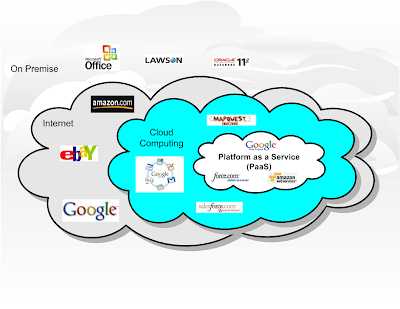
From SOA Slides


You can see from this diagram I created, PaaS takes cloud computing to the next level. Software as a Service (SaaS) are web based applications hosted at a software providers site. PaaS goes one step further and allows a company to run its infrastructure at an infrastructure provider's site. The leaders in this space are Force.com, Amazon's S3, and Google's App Engine. Currently PaaS is far from being mature as witnessed by the recent outages for each of these vendors. Many companies are starting to go the PaaS route with non mission critical applications. Over the next few years, I expect to see these platforms stabilize which will lead to a large shift in mission critical applications moving to the cloud.

So what does this mean to IT shops where technology is not their core competency? As companies move their infrastructure to the cloud, they shift a lot of the work in the areas of system administration and business continuity/disaster recovery to the provider. There will still have to be somebody within the company who is responsible for those areas but the size of these teams will continue to shrink as more systems move to the cloud. As SaaS applications in the areas of ERP, CRM, financial systems and even non business applications like application servers, BPMS and SOA tools move to the cloud, there will be a decreasing need for third party software administration for patches, upgrades, installations, etc. There will also be less development and more integration. This movement starts to commoditize development which makes outsourcing more prevalent. When I add all of these things up, I start to see a world where IT shops are putting more of an emphasis on business SMEs (subject matter experts), architects, and system integrators and a lot less emphasis on custom development and systems administration and network engineers. Before you go nuts, I am not saying that IT shops won't need these skills. I am saying that they won't need as many people to fulfill these roles.

The second area that leads me to believe that IT shops for non-technology companies will get smaller is all of the advancements in telecommunications and social networking. Bandwidth keeps getting faster and cheaper. Within the next five years, streaming media will not be such a burden on corporate intranets. Add to that the plethora of social software that is available on the web and we will start seeing a huge shift towards a mobilized workforce. It's already happening in large companies like IBM. As companies move more work to remote employees and as software becomes more of a commodity, companies might take the opportunity to fight back against rising health care costs and start outsourcing more of this type of work. That does not mean they are going to offshore everything, but they might use a combination of onshore and offshore outsourcing. I have already run across a company in the Tampa Bay area that has gone down this route. They are a bottling company who retains a very small IT shop made up of senior management, a handful of business SMEs, an architecture team, and a PMO. The IT management team works extremely close with the other executives within the company to participate in planning and strategy. All requests for projects come through this C-Level team for approval and funding. Once a project gets approved, it is put out to bid. All of the maintenance and support is off loaded to other firms as well. There is virtually no internal IT staff beyond management and architecture in this firm. It works well for them. I have not talked with them in a few years but I am sure they are looking at PaaS next.

One thing I am not saying here is that these technologies will eliminate jobs. In fact, I see more jobs being created because embracing technology is allowing companies to gain a competitive advantage on the competition who is slow to change. What I do think will happen is that many IT jobs will shift out of the traditional IT shops and move to outsourcing firms and to PaaS providers. The PaaS providers that survive will have multiple facilities across the world. These facilities will have huge data centers with armies of IT people. They will also invest heavily in innovation initiatives as they try to reduce their dependency on electricity and provide a cheaper, greener, and more reliable platform. The picture below shows a Google data center in Oregon. They are leveraging cheap land in areas with water and wind power so they can generate as much of their own energy as possible.


I know that this post may anger some and cause others to think I have lost my mind. I am simply asking some questions and trying to understand where all of this is heading. I have always been fascinated with the evolution of IT and try to understand trends before I get taken by surprise. I remember trying to grasp what the impact of PCs would be when I was a mainframe developer and I remember trying to figure out how the Internet would change our world forever. I knew both of those technologies would change things but not to the level that they have. I think cloud computing, advancements in telecommunications, and social software will combine to create changes even bigger then anything that we have seen in the past.


I read this post from Stewart Mader's blog on wiki patterns today and it talks about a challenge to the adoption of wiki is the fact that the new tools are too inexpensive or even free (open source).

Here is a key quote:

Sandy Kemsley’s fourth challenge to social media/enterprise 2.0 in organizations:
The fact that these technologies are inexpensive (or even free) and quick to implement causes them to be discounted by executives who are used to spending millions on information management systems.


Isn't it time that executives stopped running their IT shops like it is 1980? Spending millions on large vendors may make it easier for one to sleep at night, but it is not the best use of corporate dollars. I have been in IT for a long time and I have witnessed the same pattern across several companies over the last 20+ years. The pattern that I am talking about is IT puts more weight on "manageability" then they do on customer requirements. Some shops are so married to big vendors that they are not taking advantage of open source solutions or even worse, they are limiting the vendor selection process down to a set of tools that do not meet the customer's needs. When this happens, IT becomes its own worst enemy. First of all, adoption of tools that the users do not want or do not value as high as other tools can be a major challenge. I have seen my share of shelf-ware over the years. Second, forcing customers into solutions does not bode well for customer satisfaction and may cause the customers to look elsewhere next time. Third and maybe the worst case of all, sticking to the major vendors at all costs may prevent IT from selecting any tool due to high costs or lack of a sufficient tool. To put this into perspective, the user suffers because our favorite vendor can't deliver.

Here is an example. If you look at Web 2.0 tools today, most of the top tools are either open source or provided by startups or companies without billions of dollars in revenue. IT shops who still stick to principles from 20 years ago will simply not invest in enterprise blogs, wikis, and social networking tools. The big vendors either do not have the tools or the tools that they have cost a significant sum of money. Trying to justify spending a large amount of money on better collaboration tools is a major challenge. With open source or low cost alternatives, it is much easier to start small and grow adoption over time.

At the end of the day, we should understand that the reason that corporations fund IT departments is so that our internal and external customers have the tools, products, and services they need to do their job. The world is changing and IT must change with it. In addition to the normal technical requirements (manageability, scalability, etc.), the vendor selection process should consider the following:
  • Buy vs. Build (is it a core competency?)
  • Evaluate open source alternatives
  • Evaluate SaaS alternatives
  • What is the vendor's SOA strategy (integration and agility)
Is your IT shop still stuck in the 1980's? If so, what are you going to do to educate your executive team? Do the research for them and show them where technology is going. The worst thing that can happen is that people will learn something.


So many exciting changes are happening in the world of IT today. Look at all the hot topics from around the net that we read about each day:

  • Virtualization
  • Web 2.0
  • SOA
  • BPM
  • Saas
  • Outsourcing
  • Open Source
  • Mobile Computing
  • Event Driven Architectures
  • Mashups
  • Collective Intelligence
  • Super fast chip technology
What does this all mean to the future of IT? Most of these technologies (if done right) will impact the workplace in a variety of ways. Some of these technologies will enable people to be fully functional from remote locations (Mobile Computing, Web 2.0, Mashups, Collective Intelligence). Some of these technologies will eliminate human processes both in the business (BPM, SOA, Event Driven Architectures) and IT (Virtualization, Outsourcing, SaaS). Others will make us less dependent on the big vendors (Open Source, Virtualization). Then there are the advancements in chip technology and memory which can really rock our world. Can you say diskless PCs?

So as I read article after article, day after day, I begin to wonder what this all means to the working people in IT. I can be pessimistic about the future of IT and paint a picture that looks like this:
  • Mass virtualization - elimination of many systems administration and networking jobs
  • Mass Outsourcing - Most of development farmed out due to cost effectiveness of remote development (both onshore and offshore)
  • Less internal development - Reduction of development jobs due to effective end user tools (BPM, Mashups, Web 2.0), external development (Outsourcing, SaaS), and improved collaboration and automation (Collective Intelligence, Event Driven Architectures, SOA)
Or I could take an optimistic view of the future of IT:
  • Business Alignment - business heavily relies on IT for automating and streamlining business processes (BPM, SOA, Event Driven Architectures)
  • Enterprise architecture - Architecture becomes key differentiator and enabler
  • Rapid development, less maintenance - Tools (Mashups, Web 2.0) and architecture provide a platform to rapidly deploy. IT delivers loosely couple services, not proprietary monolithic applications, which reduces maintenance and allows for more new development.
  • Cost effective computing - Business looks to IT as a partner and an enabler instead of a cost center. IT makes the business efficient (Mobile Computing, fast chip technology, collective intelligence) while being cost effective (SaaS, Virtualization, Out Sourcing, Open Source, BPM, etc.).
My belief is that it will come down to the IT leadership, mainly the CIO. The CIO needs to measure and promote the value of the IT department as we move through these dramatic changes in technology over the next few years. He or she must be a trusted business partner to the CEO, CFO, and COO. IT should be proactive and start implementing these technologies (where it makes sense) to enable the business, as opposed to waiting for the business to tell IT to implement these technologies to reduce costs and headcount.

So what is your view of the future of IT? Is it pessimistic or optimistic? If it is pessimistic, what are you doing to change it?


I recently have experimented with Ubuntu at work and wrote an article called "Eat my own dog food" about my experience. I got into a philosophical debate about the value of open source with one of my readers and also was the recipient of smears and smirks from a few folks at work.

Obviously there are a lot of folks in IT who are not doing their homework when it comes to Open Source. In this post I will educate those who haven't been paying attention to the monumental shift in acceptance of Open Source technologies over the last few years.

So where do I start? For those who still doubt and/or dislike Open Source, here is the definition of Open Source from www.opensource.org

"Open source is a development method for software that harnesses the power of distributed peer review and transparency of process. The promise of open source is better quality, higher reliability, more flexibility, lower cost, and an end to predatory vendor lock-in."

For the uninformed, Open Source is more then just Linux on the desktop. Ok, enough housekeeping.

Now let's dive into how companies are making strategic business decisions to embrace Open Source technologies. In this article from CNet, Forrester Research states that "
over 60 percent of 140 companies surveyed plan to use, or are using, open-source products". Many new startups are leveraging open source to reduce startup costs and improve speed to market. The article continues by saying, "By tapping into the open-source world, fledgling software outfits can assemble their software products from freely available components". Continuing further through the article they point out how "established software companies, such as BEA Systems, Computer Associates International, IBM and Novell, have spearheaded open-source projects as a way of vetting new code and getting their products into the hands of potential customers."

This is a very important point. Many of the people who mock Open Source are using it in the products and services they use everyday. Google and Amazon both run on Linux and Yahoo runs on BSD. IBM is a big believer in Linux and both IBM and BEA leverage Eclipse for their development environment. Go to this page and you will see Oracle pushing Python, Ruby, and many others. So if using Open Source is strategic for billion dollar companies like IBM, Oracle, and BEA, why do I get crazy looks when I mention it at work or on this blog?

Here is another believer. Researcher IDC states that Open Source is "...the most significant all-encompassing and long-term trend that the software industry has seen since the early 1980s and predicted it would fundamentally change the value proposition of packaged software for customers." But don't stop there. Take a look at what is going on around the world. Apache is powering 58% of all websites. Firefox has increased its market share by over 43% in the last year up to 13.67%. IE is down to 79% from 99% a few years ago. Some universities are moving to gmail and other free alternatives because they are tired of the costs and the headaches that come with trying to maintain and secure Outlook. IBM just endorsed MySQL. Dell is now shipping laptops and PC's with Ubuntu. I could go on forever but you get the point by now.

What is even more interesting to me is that with the adoption of SaaS, Web 2.0 technologies, and services, the relevance and the dependency on operating systems is dramatically decreasing. Once you start running your critical applications using the SaaS model or you start deploying your applications with robust UIs in a browser, who really cares what the OS is any more?

You can ignore Open Source but it isn't going away. As leaders in IT, we have a responsibility to the folks who write us checks to put aside our personal preferences and pursue technologies that make good business sense. For those companies that put together 2 and 3 year plans, you should at least have a strategy to investigate opportunities to leverage Open Source and spend a few R&D dollars to understand it better.


Subscribe to: Posts (Atom)

My favorite sayings

"If you don't know where you're going, any road will get you there"

"Before you build a better mouse trap, make sure you have some mice"