I am a huge fan of social software, especially when it comes to networking with experts in technology. Those of you who follow me on Twitter know that I am a fanatic NY Giants fan who travels from Florida to hostile stadiums in places like Dallas and Pittsburgh to watch my beloved GMen go to battle. Last week, Jordan Haberfield, an expert at finding and placing talented SOA technicians at major corporations, asked me about a wager on the game between the Giants and his favorite team, the sell proclaimed America's Team and arch rival Dallas Cowboys. My normal bet with friends is for lunch or a few beers. Since Jordan is in New Jersey and I am in Florida, that bet did not make sense. What did make sense was betting that the loser would have to post a congrats on his blog.
Well, that was like taking candy from a baby as the Giants put a thumping on the depleted and heartless Cowpokes. To see Jordan pay his debts, go to his website called Agile Elephant. Jordan did manage to find a picture of one of the few positive plays that his Cowboys had in the game. My favorite Cowboy moment is still the Terrell Owens "My Quarterback" crying session after the Giants knocked the 'Boys out of the playoffs last year.
So add wagers to your list of things you can do with social software. It's the gift that keeps on giving and is searchable on Google!
A little off topic today.
Each evening I help my kids with their homework. They are both very capable with computers. My daughter has been blogging about her pets since she was 8 (she is 10 now). She creates blog entries complete with multi media with no assistance from me. Other than creating the Blogger template for her, all of the work is her own. My son is the wizard of Wikipedia which he discovered on his own a few years back. The fact that my kids are computer savvy gives them a huge advantage when it comes to learning.
For example, my son has a weekly technology project where he must report on how certain technologies work. Like me, he is fascinated by how things are manufactured. So each week we pick an item that we are familiar with and he Google's it. Then we find a video on the manufacturing process like the one below about how bubble gum is made.
This is so much more effective than how I had to learn. I was forced to use either an outdated encyclopedia that my parents purchased or I had to go to the town library. Neither of these experiences offered rich media options. I often had to perform a ton of reserach to get the desired knowledge in order to write my papers. My son and I are able to knock these weekly assignments out in a half hour. At the same time he gets to see the actual manufacturing process in the video which enhances the learning experience. Then he notices similar videos and starts learning how marbles are manufactured.
It is so obvious to me that this generation can consume large amounts of pertinent information in short periods of time. My kids are very up to speed on the current election process and even know who the Governor of Florida is. I am not sure I knew who the governor of NY was when I grew up there in high school. This is the beauty of Web 2.0 and Internet technologies. The whole ranking, tagging, and social networking processes that are taking place are allowing my kids to learn about the world around them.
Here is another great example. My daughter gets assigned a science project. So I am prepared to carve out numerous hours each night to help her get this done. Instead, I see here collaborating with classmates on Google Talk and exchanging links and images. She would draft a story board on paper, scan it, and send it to her classmate. I was floored. She completed the entire project without my help using free collaboration technology on the web. And she's 10 years old! So I ask myself. Are you smarter than a 5th grader?
 For those of you who have been reading my blog for the last two years, you might know that after 13 years at my previous job I left the company this summer to pursue multiple opportunities that were available to me. I have been doing some consulting and freelance writing in the mean time but have finally found my new gig. I will be the CTO/Chief Architect for a startup (more details forthcoming in the future) and will have the opportunity to work on some of the newer technology initiatives. So here are some of the future blog topics that I will start covering in 2009 once I get rolling:
- SOA - can't seem to let it go! As I wrote in a post at CIO.com, I believe SOA is not just for legacy systems and can be the foundation that startups can leverage as a competitive advantage (see the reasons why)
- Cloud Computing - Startups typically have low budgets and leveraging platform (PaaS) and/or Infrastructure as a Service (IaaS) can be a great way to both minimize costs and reduce time to market. As I go through the requirements analysis, risk analysis, vendor analysis, proof of concepts, prototypes, and deal with issues such as stability and privacy, I will share my lessons learned here.
- Open Source - We will likely leverage many open source solutions and I will discuss those experiences and decision points here.
- Social Software - The company is based in the North East and I live in Florida. It is highly possible that the team I build will be dispersed all over the country and possibly even the world. There will be great lessons learned discussions as well as evaluations of tools to help enable working remotely (virtual whiteboards, live meetings, SaaS solutions for defect tracking, etc.).
- Agile - One of our goals is to deliver quickly and at low cost. This involves a lot of the above mentioned topics and will also lead us into the world of Agile Development. I will discuss our challenges and lessons learned in this area as well.
- C-Level IT topics - In my new role I will be working side by side with other C-Level people within the company as well as with C-Level people of partner and customer companies. I will have to hit the road and sell and/or promote our products/services and will try to shed some light on some of the interesting topics I come across.
- Misc - Other topics that might be worthy of discussing (examples: impacts of financial crisis, VC funding, selling technology to business people and customers, etc.)
- SOA Governance by Todd Biske
- SOA Cookbook by Michael Havey
And finally, I am open to covering any topic that any of my readers would like me to discuss whether it is on this blog, over the phone, or in person. Whenever I travel I send a Tweet on Twitter to let people know where I can be found. I will be in Pittsburgh from Saturday 10/25 through Monday 10/27 if anybody lives there and would like to meet. Don't bug me from 4:15-7:15pm on Sunday because I'll be at Heinz Field pulling for my Giants against a tough Steeler team. The rest of next week I am at the EDM Summit in Orlando.
I look forward to sharing these topics with you all. Over the next two months my focus will be on the business plan and creating a team. We officially launch the company in the December-January time frame. At that point expect to see more discussions on the topics I mentioned above.
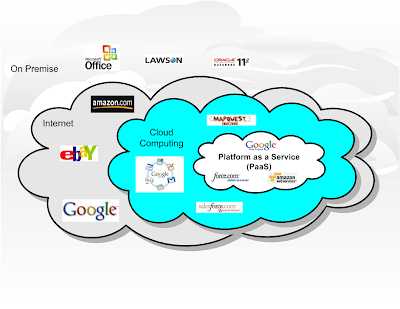
This is a question I have been asking myself lately as I look at trends in technology. There are two major areas that lead me to think that IT shops for non-technology companies (banks, retailers, insurance, manufacturing, etc.) will continue a trend of reducing headcount over the next 5-10 years. The first is cloud computing and specifically, Platform as a Service (PaaS).
 |
| From SOA Slides |
You can see from this diagram I created, PaaS takes cloud computing to the next level. Software as a Service (SaaS) are web based applications hosted at a software providers site. PaaS goes one step further and allows a company to run its infrastructure at an infrastructure provider's site. The leaders in this space are Force.com, Amazon's S3, and Google's App Engine. Currently PaaS is far from being mature as witnessed by the recent outages for each of these vendors. Many companies are starting to go the PaaS route with non mission critical applications. Over the next few years, I expect to see these platforms stabilize which will lead to a large shift in mission critical applications moving to the cloud.
So what does this mean to IT shops where technology is not their core competency? As companies move their infrastructure to the cloud, they shift a lot of the work in the areas of system administration and business continuity/disaster recovery to the provider. There will still have to be somebody within the company who is responsible for those areas but the size of these teams will continue to shrink as more systems move to the cloud. As SaaS applications in the areas of ERP, CRM, financial systems and even non business applications like application servers, BPMS and SOA tools move to the cloud, there will be a decreasing need for third party software administration for patches, upgrades, installations, etc. There will also be less development and more integration. This movement starts to commoditize development which makes outsourcing more prevalent. When I add all of these things up, I start to see a world where IT shops are putting more of an emphasis on business SMEs (subject matter experts), architects, and system integrators and a lot less emphasis on custom development and systems administration and network engineers. Before you go nuts, I am not saying that IT shops won't need these skills. I am saying that they won't need as many people to fulfill these roles.
The second area that leads me to believe that IT shops for non-technology companies will get smaller is all of the advancements in telecommunications and social networking. Bandwidth keeps getting faster and cheaper. Within the next five years, streaming media will not be such a burden on corporate intranets. Add to that the plethora of social software that is available on the web and we will start seeing a huge shift towards a mobilized workforce. It's already happening in large companies like IBM. As companies move more work to remote employees and as software becomes more of a commodity, companies might take the opportunity to fight back against rising health care costs and start outsourcing more of this type of work. That does not mean they are going to offshore everything, but they might use a combination of onshore and offshore outsourcing. I have already run across a company in the Tampa Bay area that has gone down this route. They are a bottling company who retains a very small IT shop made up of senior management, a handful of business SMEs, an architecture team, and a PMO. The IT management team works extremely close with the other executives within the company to participate in planning and strategy. All requests for projects come through this C-Level team for approval and funding. Once a project gets approved, it is put out to bid. All of the maintenance and support is off loaded to other firms as well. There is virtually no internal IT staff beyond management and architecture in this firm. It works well for them. I have not talked with them in a few years but I am sure they are looking at PaaS next.
One thing I am not saying here is that these technologies will eliminate jobs. In fact, I see more jobs being created because embracing technology is allowing companies to gain a competitive advantage on the competition who is slow to change. What I do think will happen is that many IT jobs will shift out of the traditional IT shops and move to outsourcing firms and to PaaS providers. The PaaS providers that survive will have multiple facilities across the world. These facilities will have huge data centers with armies of IT people. They will also invest heavily in innovation initiatives as they try to reduce their dependency on electricity and provide a cheaper, greener, and more reliable platform. The picture below shows a Google data center in Oregon. They are leveraging cheap land in areas with water and wind power so they can generate as much of their own energy as possible.

I know that this post may anger some and cause others to think I have lost my mind. I am simply asking some questions and trying to understand where all of this is heading. I have always been fascinated with the evolution of IT and try to understand trends before I get taken by surprise. I remember trying to grasp what the impact of PCs would be when I was a mainframe developer and I remember trying to figure out how the Internet would change our world forever. I knew both of those technologies would change things but not to the level that they have. I think cloud computing, advancements in telecommunications, and social software will combine to create changes even bigger then anything that we have seen in the past.
 I know the answer to this question. Because we always have. Can we put aside our age old habits of being herded into corporate offices like cattle to sit in cubes (I call them coffins) and try to find some piece and quiet so we can create that next document, model the next design, code the next service, or develop the next prototype? Speaking of old habits, why must our two main sources of collaboration be meetings and email? Many meetings are either about status or some person needs some information to solve a problem and invites everybody under the sun to help. Most of these types of meetings add value to very few people in the meeting at the expense of the others. Isn't it time for a change? As for email, nobody has a better story about ditching email then IBM's Luis Suarez.
Here are a few reasons why I feel that I am much more productive working remotely then at the office:
- Fewer distractions
- Fewer meetings
- More tools
- More accountability
- No hour lunches
- Better work/life balance
Fewer Distractions
At the office, people are more willing to interrupt you because they can easily just walk up and ask you a question since they "know where you live". Just walking to get a cup of coffee can turn into a handful of hallway conversations, some work related, some not. When working remotely, people tend to reach out to you only after they have tried to actually find answers to their questions as opposed to just bugging the expert. Don't get me wrong, I love helping my fellow worker, but sometimes it is too easy to ask before people actually think.
Fewer Meetings
Less meetings does not equate to less collaboration. It means less scheduled interruptions. Now some meetings are necessary, but most meetings can be avoided if people were allowed to use collaboration tools to ask and answer questions. Instead of holding numerous meetings, I prefer to have ongoing conversations via some messaging tool (IM, chat, Twitter, etc.). If I really need to focus on a task I can mark myself as away. There are many interesting and free tools that I have been experimenting with that have virtual white boards, video conferencing, and chat all integrated into one platform. Google Groups is another way to set up a collaboration area for discussion threads, document sharing, and archiving.
More tools
Many corporations see tools like instant messaging, chat, Twitter, blogs, wikis and others as a security threat and block them. This is almost comical since everyone simply uses their phones to access these tools anyways. Wouldn't people be more productive using these tools on their computer then on their phone? (See my article called Security or Insecurity?) When you work remotely, you can use the tools of your choice to collaborate. Even if I was forced to use a locked down corporate laptop at home, I would fire up my own PC to get access to the tools I need to do my job.
More accountability
Some may disagree with me on this one. I believe that most worthy employees feel more obligated to focus and deliver because of the perception by management that working remotely allows people to screw off. I know that whenever I telecommuted, I sent my boss an email telling him what I expected to deliver and followed it with updates at the end of the day on what I accomplished. I felt privileged every time I worked from home and felt obligated to prove to management that I was providing value remotely.
No hour lunches
For me personally, a lunch break while working remotely, is the time it takes to get up from my desk, make a sandwich, and return to my desk (5 minutes). A lunch break at work is an escape from the daily grind at the office and usually takes an hour between the drive, ordering, getting served, getting the check, and driving back.
Better work/life balance
When I used to drive into the office every day, I would wake up at 6 to 6:30, catch up on my daily reading, and leave by 7-7:15am. Forty-five minutes and $10 of gas later, I would be at my desk by 8am. Typically I worked until 6-6:30pm and then spent another forty-five minutes and $10 in gas to get home. Now it is after 7pm. I have missed all of the kids sporting events and now its time to do help them with homework. Dinner fits somewhere in between and before you know it is after 9pm and you still have work to do before tomorrow. The cycle continues day in day out.
Now let's look at working remotely. I wake up around 7am. Catch up on my news and technology reading and start working by 8am. I work straight through until 6pm and am able to catch my kids soccer practice if I chose. We can get their homework done earlier, eat at a decent time, and still have time to play a game of Skip-O, tile rummy, or watch the Discovery Channel. Then, if I need to do more work after they go to bed, I am relaxed and feel like I am actually part of the family and not just part of their daily schedule. I also have a few more green backs in my pocket because I am not putting $75 in my tank every three days. Life is good!
Yes it can be done!
CIO.com is running a 3-part series on how a company named Chorus transformed their workforce to be entirely remote. If you look at the typical IT shop today, they are all leveraging some form of outsourcing, whether it is onshore, offshore, or both. In either case, there are a number of workers working remotely from some location other then where the IT shop is based. The irony is that these teams in other countries or in consulting firms within the states are all leveraging several of the tools that I mentioned above to effectively collaborate amongst themselves. I worked on a project recently where the consulting company had a few people onsite, some in Texas, Seattle, and Atlanta, and an offshore team in Macedonia. They were all productive from remote places across the globe. But mysteriously, telecommuting was frowned upon by the corporate culture. Don't figure! What message does that send to the employees of the company? Is it this message..."we trust our vendors to be professionals remotely, but not our own people...."?
Barriers for companies to embrace a remote environment
Having a handful of people working remotely is not a big deal. Mobilizing your workforce is. Part 2 and Part 3 of the CIO.com story about Chorus talks about the planning and the transition that they went through. Here are some of the barriers that I see that prevents companies from embracing remote work.
- Perception and resistance to change
- Requires capital and must be a priority project
- Needs business justification
- Requires good management and accountability
Many people perceive that their employees just won't be productive away from the watchful eyes of their managers. For some people this may be true. Then again, why are you paying people that you can't trust? Other people just fear change or won't risk taking on any challenging project.
Capital and Priority
Like any other enterprise initiative, a project of this magnitude requires executive level support, a well thought out strategy and project plan, capital funds, and a high enough priority that the milestones can be achieved. Oh, and don't forget to address the human side of change.
Business Justification
If it is not good for the bottom line, then don't bother. That goes for any project these days. Whether the savings is in reduced leases, power consumption, reduced employee turnover, or whatever, you should never ask for capital without the appropriate justification. While you are at it, don't forget to collect metrics to show management at a later date that the investment was worth it.
Good Management and Accountability
To pull this off, you must work with human resources and put together a policy that clearly set expectations. These guidelines, often part of the employee handbook, should be signed by each person who will be working remotely. But the real key is management. If your management is not doing a good job of making their staff accountable today, good luck trying to make them accountable at home. Maybe the first question to ask is do I have the right management in place to pull this off?
And finally, once a company establishes a remote work force, here are some other advantages that they have.
- Hiring - no longer constrained to local markets
- Reduced travel expenses
- Opportunity to sell real estate assets
I realized through my recent experiments with social networking that the recruitment world is much bigger then the local market leads you to believe. With a remote force, I can hire people anywhere in the country and even in the world if I have the proper controls in place. This gives me access to the top talent in the world, not just the top talent in my city. Think about that!
Reduced Travel
A lot of travel is required to hold various meetings with teams that are dispersed across offices. With the proper collaboration tools including video conferencing, virtual whiteboards, and integrated voice/chat, many of these meetings can be performed online. There will still be times where it is critical to have face to face time, but many meetings can be held more cost effective via the Web.
Sell real estate
IBM did this a few years back. Here is a great article from their web site that discusses the benefits of a remote workforce. If a huge company like IBM can pull this off, then there is no reason why any other company cannot. Here are the benefits that IBM gets from mobilizing their workforce.
So what do you think? Is the cost of gas and the improvements in social software making mobile commuting more of a reality then a fantasy? Is your company thinking about this now? I'd love to hear your story.Productivity. Outfitting employees with mobile technology makes your business more productive because it enables employees to work from home, in transit and while visiting customers, business partners and satellite offices.
Recruitment. The ability to hire the best talent regardless of where they live can give you a leg up on competitors that still rely on a local workforce. And because most potential recruits perceive telecommuting as a benefit, this can provide a considerable advantage to your business by allowing you to fill jobs more quickly. In addition, the business becomes more efficient because lower turnover means less time spent training new employees.
Real-estate savings. With fewer people in the office, real estate expenditures and associated energy costs can potentially be reduced.
Remote computing can also help you avoid the disruption of a major move during a crucial time of growth when the business needs to focus on quality execution. A flexible workforce, often associated with the teleworking model, can also accommodate short-term spikes in business. This enables your business to add office space more judiciously rather than simply reacting to short-term demands.
Business continuity. You never know what’s going to keep your employees away from the office: inclement weather, flu or even traffic tie-ups. When employees have remote access to IT systems, they can continue working no matter what happens in or around your facility.
 I want to share with you my personal experience with social software and how it changed my career for the better.
What is social software?
Social software is a subset of Web 2.0 that allows people to collaborate with other people over the web. Examples of social software are blogs, wikis, social networking sites (Facebook, LinkedIn, MySpace, etc.), instant messaging, chat, and a whole host of dynamic content sharing tools like YouTube, Flickr, Twitter, and many others.
My Professional life before social software
Before I entered the social networking scene, a had a very small network. I had been at the same company since 1995 and did not do a good job of networking with people from previous jobs. In reality, I was basically an unknown entity outside of the walls of the building I worked in. Sure a few vendors and a few consulting firms knew me, but they knew me as a customer only. Over the years I felt the need to pursue opportunities elsewhere to broaden my experience from both a technology and business standpoint. The problem was, I didn't have a network. The only people who knew about my talents where people I worked with and I couldn't let them know I was looking. So for the past five years I applied for job after job through the old channels (job boards, classifieds, etc.). Being on the hiring side of table for so many years, I knew that my chances of my resume getting through HR were as good as hitting the lottery. So I started a journey of improving my credentials by enrolling in back to back Masters programs (Masters in IT and MBA). This made me a highly educated IT professional with no network.
Life after social networking
About a year and a half ago, I started blogging. I started out under a nickname to hide my identity so I could speak my mind without getting myself in trouble, hence the name MadGreek. I quickly found out that blogging provided a way for me to form a great network which is what my career needed. At the time I probably had 15-20 LinkedIn contacts which meant I was not getting any value from LinkedIn (I now have about 240). As I invested more of my personal time blogging, I started collaborating with talented architects, industry analysts, and various other technical IT folks from around the world.
Then I discovered Twitter. I had messed with Twitter for a short while a year ago and didn't see the value. Earlier this year my network, which is several hundred people now, were talking a lot about Twitter. So I tried it again. This time I had a great network to follow on Twitter. So I started following architects, analysts, bloggers, and various interesting people and people started following me. At the same time I started learning so much about IT trends and technologies that my company had no idea about. Through Twitter, I landed several public appearances. I have done podcasts, web interviews, presentations at Gartner and Zapthink events, you name it. All of the sudden, I became a known entity. That was my missing link.
Then I took the big step!
Then I did the unthinkable. I resigned from my job of 13 years even though I did not have a job to go to. Am I nuts? Not really. By reaching out to quality people in my network, I have started discussions about job opportunities with 5 different companies in the last two weeks. I get emails constantly from people in my network with opportunities like VP of architecture, SOA lead practitioner, enterprise architect, and various others. Unfortunately, many of these jobs are not in Florida and require me to move, but some are consulting and others are virtual. I don't even look at the job boards anymore because it is a total waste of time!
In the driver's seat
So now I am sitting in the driver's seat. I have successfully marketed my own personal brand through blogging and public appearances. I know a lot of people in the industry who know a lot of important people. I can now choose the best possible opportunity instead of grabbing the first available job that I can find. I can choose to do something that I have a lot of passion and energy for which is research technology and emerging trends and help people with their struggles in delivering enterprise initiatives. All of this is possible because of the power of social networking. My advice to those of you who dread going to your job each day is get out there and start socializing. Stay clear of religion and politics, respect people's opinions, and enjoy the experience. Remember, recruiters can Google your name once you engage on the web.
It's not just for personal benefit
But social software also provides great benefits for corporations. The last two years I initiated and led a large SOA/BPM effort. These same tools that provided all of the personal benefits I mentioned above, also provided an incredible amount of value to our SOA project. Much of our research came from blogs and wikis. When I was preparing the RFP for the SOA stack, Eric Roch posted this gem. Over time I started collaborating more and more with sharp SOA experts like Eric, the guys from Zapthink, Todd Biske, Brenda Michelson, and many others. We shared real life stories about what has and hasn't worked on SOA projects, what things to think about, what to do and not to do, who the experts are on certain topics, etc. You don't get these types of conversations talking to vendors. They only tell you the good stuff and hide the scary stuff. I truly believe that if it was not for social software, our SOA initiative would not have been half of the success that it is. Now when people from my company attend web casts or conferences on SOA or BPM, they come away saying, "We already know all of that".
Collaborate or Die
In conclusion, those companies or individuals who shy away from social software will eventually render themselves irrelevant. Technology and business is changing so fast that if you don't get "out there" you will be lost in the ways of yesterday, and become as relevant as a Y2K developer. So get out there, build a network, learn from others, share your experiences so we can learn from you and revitalize your career!


