

Many companies are investing heavily in SOA these days. At the same time, IT is being challenged to reduce its costs. But to provide the technologies to reduce costs, we first must spend tons of money, right? Wrong! Read my post on CIO.com this week called Tight Budgets? Try Open Source SOA.
I have spent thirteen years in the loyalty marketing industry and have seen some amazingly complex algorithms for targeting consumers based on all kinds of criteria. There are lost shoppers, top shoppers, brand switchers, brand loyals, and various other categories of consumers that brand managers try to reach out and communicate to. Social media is changing the way that brand managers need to think. Check out this interesting presentation I stumbled upon on Slideshare today.
What is interesting is that consumers are in total control of when and how they receive advertisements and incentives. We have Tivo to fast forward past commercials, popup blockers to block adds, and we have the power to choose not to go to web sites covered with advertising. So now, brand managers must listen to their consumers and coexist within their networks. This is changing how we view loyalty. Brand managers need to reach out to social networks that have a large following of loyal community members. If they can get a well known person within a social network interested in their brand, many others will follow. When people like popular blogger Robert Scoble talk about a product or service it takes on a viral effect. When Scoble and the folks at Techcrunch started slamming Twitter and talking up Friendfeed when Twitter was crashing several times a day, huge numbers of loyal community members followed. Some of these popular bloggers have as much of an impact as a product review in the New York Times.
So what does this mean for brand managers? Well it means they need to pay attention to a new kind of loyalty marketing. I call it social loyalty. No longer do the brand managers have a captive audience where they can spoon feed us whatever message they want. Now they have to cater to consumers, especially the popular leaders within social networks. The game is changing and the companies that are not paying attention are going get left behind.
This is a question I have been asking myself lately as I look at trends in technology. There are two major areas that lead me to think that IT shops for non-technology companies (banks, retailers, insurance, manufacturing, etc.) will continue a trend of reducing headcount over the next 5-10 years. The first is cloud computing and specifically, Platform as a Service (PaaS).
 |
| From SOA Slides |
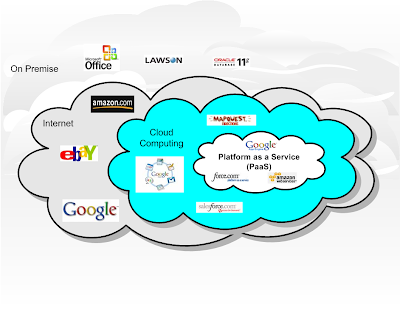
You can see from this diagram I created, PaaS takes cloud computing to the next level. Software as a Service (SaaS) are web based applications hosted at a software providers site. PaaS goes one step further and allows a company to run its infrastructure at an infrastructure provider's site. The leaders in this space are Force.com, Amazon's S3, and Google's App Engine. Currently PaaS is far from being mature as witnessed by the recent outages for each of these vendors. Many companies are starting to go the PaaS route with non mission critical applications. Over the next few years, I expect to see these platforms stabilize which will lead to a large shift in mission critical applications moving to the cloud.
So what does this mean to IT shops where technology is not their core competency? As companies move their infrastructure to the cloud, they shift a lot of the work in the areas of system administration and business continuity/disaster recovery to the provider. There will still have to be somebody within the company who is responsible for those areas but the size of these teams will continue to shrink as more systems move to the cloud. As SaaS applications in the areas of ERP, CRM, financial systems and even non business applications like application servers, BPMS and SOA tools move to the cloud, there will be a decreasing need for third party software administration for patches, upgrades, installations, etc. There will also be less development and more integration. This movement starts to commoditize development which makes outsourcing more prevalent. When I add all of these things up, I start to see a world where IT shops are putting more of an emphasis on business SMEs (subject matter experts), architects, and system integrators and a lot less emphasis on custom development and systems administration and network engineers. Before you go nuts, I am not saying that IT shops won't need these skills. I am saying that they won't need as many people to fulfill these roles.
The second area that leads me to believe that IT shops for non-technology companies will get smaller is all of the advancements in telecommunications and social networking. Bandwidth keeps getting faster and cheaper. Within the next five years, streaming media will not be such a burden on corporate intranets. Add to that the plethora of social software that is available on the web and we will start seeing a huge shift towards a mobilized workforce. It's already happening in large companies like IBM. As companies move more work to remote employees and as software becomes more of a commodity, companies might take the opportunity to fight back against rising health care costs and start outsourcing more of this type of work. That does not mean they are going to offshore everything, but they might use a combination of onshore and offshore outsourcing. I have already run across a company in the Tampa Bay area that has gone down this route. They are a bottling company who retains a very small IT shop made up of senior management, a handful of business SMEs, an architecture team, and a PMO. The IT management team works extremely close with the other executives within the company to participate in planning and strategy. All requests for projects come through this C-Level team for approval and funding. Once a project gets approved, it is put out to bid. All of the maintenance and support is off loaded to other firms as well. There is virtually no internal IT staff beyond management and architecture in this firm. It works well for them. I have not talked with them in a few years but I am sure they are looking at PaaS next.
One thing I am not saying here is that these technologies will eliminate jobs. In fact, I see more jobs being created because embracing technology is allowing companies to gain a competitive advantage on the competition who is slow to change. What I do think will happen is that many IT jobs will shift out of the traditional IT shops and move to outsourcing firms and to PaaS providers. The PaaS providers that survive will have multiple facilities across the world. These facilities will have huge data centers with armies of IT people. They will also invest heavily in innovation initiatives as they try to reduce their dependency on electricity and provide a cheaper, greener, and more reliable platform. The picture below shows a Google data center in Oregon. They are leveraging cheap land in areas with water and wind power so they can generate as much of their own energy as possible.

I know that this post may anger some and cause others to think I have lost my mind. I am simply asking some questions and trying to understand where all of this is heading. I have always been fascinated with the evolution of IT and try to understand trends before I get taken by surprise. I remember trying to grasp what the impact of PCs would be when I was a mainframe developer and I remember trying to figure out how the Internet would change our world forever. I knew both of those technologies would change things but not to the level that they have. I think cloud computing, advancements in telecommunications, and social software will combine to create changes even bigger then anything that we have seen in the past.
Dave Linthicum's weekly podcast discusses my article on CIO.com about the top 10 mistakes people make while trying to deliver SOA. Dave does a great job breaking down the list. You can hear the podcast here.
 I know the answer to this question. Because we always have. Can we put aside our age old habits of being herded into corporate offices like cattle to sit in cubes (I call them coffins) and try to find some piece and quiet so we can create that next document, model the next design, code the next service, or develop the next prototype? Speaking of old habits, why must our two main sources of collaboration be meetings and email? Many meetings are either about status or some person needs some information to solve a problem and invites everybody under the sun to help. Most of these types of meetings add value to very few people in the meeting at the expense of the others. Isn't it time for a change? As for email, nobody has a better story about ditching email then IBM's Luis Suarez.
Here are a few reasons why I feel that I am much more productive working remotely then at the office:
- Fewer distractions
- Fewer meetings
- More tools
- More accountability
- No hour lunches
- Better work/life balance
Fewer Distractions
At the office, people are more willing to interrupt you because they can easily just walk up and ask you a question since they "know where you live". Just walking to get a cup of coffee can turn into a handful of hallway conversations, some work related, some not. When working remotely, people tend to reach out to you only after they have tried to actually find answers to their questions as opposed to just bugging the expert. Don't get me wrong, I love helping my fellow worker, but sometimes it is too easy to ask before people actually think.
Fewer Meetings
Less meetings does not equate to less collaboration. It means less scheduled interruptions. Now some meetings are necessary, but most meetings can be avoided if people were allowed to use collaboration tools to ask and answer questions. Instead of holding numerous meetings, I prefer to have ongoing conversations via some messaging tool (IM, chat, Twitter, etc.). If I really need to focus on a task I can mark myself as away. There are many interesting and free tools that I have been experimenting with that have virtual white boards, video conferencing, and chat all integrated into one platform. Google Groups is another way to set up a collaboration area for discussion threads, document sharing, and archiving.
More tools
Many corporations see tools like instant messaging, chat, Twitter, blogs, wikis and others as a security threat and block them. This is almost comical since everyone simply uses their phones to access these tools anyways. Wouldn't people be more productive using these tools on their computer then on their phone? (See my article called Security or Insecurity?) When you work remotely, you can use the tools of your choice to collaborate. Even if I was forced to use a locked down corporate laptop at home, I would fire up my own PC to get access to the tools I need to do my job.
More accountability
Some may disagree with me on this one. I believe that most worthy employees feel more obligated to focus and deliver because of the perception by management that working remotely allows people to screw off. I know that whenever I telecommuted, I sent my boss an email telling him what I expected to deliver and followed it with updates at the end of the day on what I accomplished. I felt privileged every time I worked from home and felt obligated to prove to management that I was providing value remotely.
No hour lunches
For me personally, a lunch break while working remotely, is the time it takes to get up from my desk, make a sandwich, and return to my desk (5 minutes). A lunch break at work is an escape from the daily grind at the office and usually takes an hour between the drive, ordering, getting served, getting the check, and driving back.
Better work/life balance
When I used to drive into the office every day, I would wake up at 6 to 6:30, catch up on my daily reading, and leave by 7-7:15am. Forty-five minutes and $10 of gas later, I would be at my desk by 8am. Typically I worked until 6-6:30pm and then spent another forty-five minutes and $10 in gas to get home. Now it is after 7pm. I have missed all of the kids sporting events and now its time to do help them with homework. Dinner fits somewhere in between and before you know it is after 9pm and you still have work to do before tomorrow. The cycle continues day in day out.
Now let's look at working remotely. I wake up around 7am. Catch up on my news and technology reading and start working by 8am. I work straight through until 6pm and am able to catch my kids soccer practice if I chose. We can get their homework done earlier, eat at a decent time, and still have time to play a game of Skip-O, tile rummy, or watch the Discovery Channel. Then, if I need to do more work after they go to bed, I am relaxed and feel like I am actually part of the family and not just part of their daily schedule. I also have a few more green backs in my pocket because I am not putting $75 in my tank every three days. Life is good!
Yes it can be done!
CIO.com is running a 3-part series on how a company named Chorus transformed their workforce to be entirely remote. If you look at the typical IT shop today, they are all leveraging some form of outsourcing, whether it is onshore, offshore, or both. In either case, there are a number of workers working remotely from some location other then where the IT shop is based. The irony is that these teams in other countries or in consulting firms within the states are all leveraging several of the tools that I mentioned above to effectively collaborate amongst themselves. I worked on a project recently where the consulting company had a few people onsite, some in Texas, Seattle, and Atlanta, and an offshore team in Macedonia. They were all productive from remote places across the globe. But mysteriously, telecommuting was frowned upon by the corporate culture. Don't figure! What message does that send to the employees of the company? Is it this message..."we trust our vendors to be professionals remotely, but not our own people...."?
Barriers for companies to embrace a remote environment
Having a handful of people working remotely is not a big deal. Mobilizing your workforce is. Part 2 and Part 3 of the CIO.com story about Chorus talks about the planning and the transition that they went through. Here are some of the barriers that I see that prevents companies from embracing remote work.
- Perception and resistance to change
- Requires capital and must be a priority project
- Needs business justification
- Requires good management and accountability
Many people perceive that their employees just won't be productive away from the watchful eyes of their managers. For some people this may be true. Then again, why are you paying people that you can't trust? Other people just fear change or won't risk taking on any challenging project.
Capital and Priority
Like any other enterprise initiative, a project of this magnitude requires executive level support, a well thought out strategy and project plan, capital funds, and a high enough priority that the milestones can be achieved. Oh, and don't forget to address the human side of change.
Business Justification
If it is not good for the bottom line, then don't bother. That goes for any project these days. Whether the savings is in reduced leases, power consumption, reduced employee turnover, or whatever, you should never ask for capital without the appropriate justification. While you are at it, don't forget to collect metrics to show management at a later date that the investment was worth it.
Good Management and Accountability
To pull this off, you must work with human resources and put together a policy that clearly set expectations. These guidelines, often part of the employee handbook, should be signed by each person who will be working remotely. But the real key is management. If your management is not doing a good job of making their staff accountable today, good luck trying to make them accountable at home. Maybe the first question to ask is do I have the right management in place to pull this off?
And finally, once a company establishes a remote work force, here are some other advantages that they have.
- Hiring - no longer constrained to local markets
- Reduced travel expenses
- Opportunity to sell real estate assets
I realized through my recent experiments with social networking that the recruitment world is much bigger then the local market leads you to believe. With a remote force, I can hire people anywhere in the country and even in the world if I have the proper controls in place. This gives me access to the top talent in the world, not just the top talent in my city. Think about that!
Reduced Travel
A lot of travel is required to hold various meetings with teams that are dispersed across offices. With the proper collaboration tools including video conferencing, virtual whiteboards, and integrated voice/chat, many of these meetings can be performed online. There will still be times where it is critical to have face to face time, but many meetings can be held more cost effective via the Web.
Sell real estate
IBM did this a few years back. Here is a great article from their web site that discusses the benefits of a remote workforce. If a huge company like IBM can pull this off, then there is no reason why any other company cannot. Here are the benefits that IBM gets from mobilizing their workforce.
So what do you think? Is the cost of gas and the improvements in social software making mobile commuting more of a reality then a fantasy? Is your company thinking about this now? I'd love to hear your story.Productivity. Outfitting employees with mobile technology makes your business more productive because it enables employees to work from home, in transit and while visiting customers, business partners and satellite offices.
Recruitment. The ability to hire the best talent regardless of where they live can give you a leg up on competitors that still rely on a local workforce. And because most potential recruits perceive telecommuting as a benefit, this can provide a considerable advantage to your business by allowing you to fill jobs more quickly. In addition, the business becomes more efficient because lower turnover means less time spent training new employees.
Real-estate savings. With fewer people in the office, real estate expenditures and associated energy costs can potentially be reduced.
Remote computing can also help you avoid the disruption of a major move during a crucial time of growth when the business needs to focus on quality execution. A flexible workforce, often associated with the teleworking model, can also accommodate short-term spikes in business. This enables your business to add office space more judiciously rather than simply reacting to short-term demands.
Business continuity. You never know what’s going to keep your employees away from the office: inclement weather, flu or even traffic tie-ups. When employees have remote access to IT systems, they can continue working no matter what happens in or around your facility.
 I recently have started blogging about SOA for CIO.com. My first post is in response to the Burton Group's report that most SOA failures are due to people and cultural issues. I have been saying this for quite some time now so it is good to hear the experts confirm my opinions.
So the next logical question is why are people making SOA fail? I answered this in David Letterman style with a top 10 list of my own. Read the rest of the story here.
 Keeping the enterprise secure is a challenge these days. Security specialists are concerned with a variety of threats from external issues (worms, viruses, rootkits, identity theft, etc.) to internal issues (lost/stolen laptops, data breaches, voluntary or involuntary exposure of confidential information, etc.). Unfortunately, many IT shops look at security as a technology issue and forget to address the business side of security. Some shops lock down their enterprise to the point where they impact the business's ability to be successful. While researching this topic I came across an excellent abstract from the Software Engineering Institute written by Richard A. Caralli and William R. Wilson. This abstract is a must read.
What is the goal of an organization's security strategy?
Security experts must understand that everybody in the organization is their customer. Many IT shops act more like a dictatorship and continue to put policies and technologies in place that make IT a hindrance to the business. Caralli & Wilson remind us that...
..."the ultimate benefactor of the security activities that an organization undertakes should be the organization itself."
..."the industry’s affinity for technology-based solutions alienates the “business people” in the organization."
..."anything that impedes assets and processes from doing their jobs potentially derails the organization’s ability to be successful."They suggest that the CSO (Chief Security Officer) reports to someone from the business. I don't disagree, however, if the IT department is business focused, I see no reason why the CSO can't report to the CIO. The same argument is often made for business analysts, project management, and even the Chief Architect. This is a direct result of IT becoming out of touch with the business and taking a technology first approach to all problems instead of a business first approach. The authors go on to say...
"Managing security in the context of the organization’s strategic drivers, provides both advantages and conflict. On the one hand, this approach ensures that the goals of security management are forged from and aligned with the high-level goals of the organization. On the other hand, the strategic drivers and needs of the organization are often in conflict with the actions required to ensure that assets and processes remain productive. In addition, as the organization is exposed to more complexity and uncertainty (because of the increasing use of technology and the pace at which the organization’s risk environment changes), keeping security activities and strategic drivers aligned becomes more difficult. In the end, finding the right balance between protecting the organization’s core assets and processes and enabling them to do their job becomes a challenge for security management—and a significant barrier to effectiveness."Examples of IT security becoming a barrier
Security has similar issues as governance, standards, best practices, and enterprise architecture when the strategy is too technology focused. A great example is IT's resistance to adopt collaboration technologies like social networking, instant messaging, and even wireless access. Security professionals are often so insecure, that they lock down the enterprise to the point where they stifle innovation and productivity. All of the fears that I keep hearing related to collaboration technologies are the same fears I heard when companies where looking into providing Internet access years back. To me, it is the fear of the unknown. Instead of trying to live in the mainframe era of the 60's and 70's where everything was centrally controlled and nothing was acceptable unless it went through the all-powerful administrators, IT people need to accept the fact the world revolves around the business and not IT. We need to change our old ways of thinking and acknowledge that as technology continues to change at a rapid pace our strategies need to change with it.
How do we solve this problem?
Whether the CSO (or whatever the title of the security leader is) reports into the business or IT is not relevant to me.What is important is, this person must fully understand the overall business strategy and the related IT strategy. A too rigid security strategy can hinder IT from doing their jobs as much if not more then it can impact the business. The armies of people in IT building systems and keeping the lights on are customers of the security office as well. The security strategy should be one that is created with the collaboration of representatives in both the business and IT. Within IT, the strategy needs input from more then just security and infrastructure departments. Caralli & Wilson recommend...
"In pursuit of addressing the challenges noted herein, the first obstacle that an organization must confront is to determine what they are trying to accomplish with their security activities. In essence, the organization must ask what benefits they get from “doing security.” The organizational perspective is essential to determining these benefits and for setting appropriate targets for security."
"A resilient approach transforms the basic premise of security - that of locking down an asset so that it is free from harm—to one that positions security as a contributor to strengthening the organization’s ability to adapt to new risk environments and accomplish its mission. Aiming to make the organization more sensing, agile, and prepared provides a clearer purpose, direction, and context for security management. Looking beyond security (to resiliency) may provide the change in perspective that organizations need to balance security and risk management with the organization’s strategic drivers."Next steps
If you are a business owner or a leader within IT, you should read the abstract and ask yourself, "is our security strategy just another mechanism for IT to say NO to its customers or is it keeping us secure while still allowing the enterprise to meet its goals". If it's the former, I suggest that you start a conversation with the leaders within company and take a fresh look at security. After all, Insecurity should not be the driver for your security strategy.
 I want to share with you my personal experience with social software and how it changed my career for the better.
What is social software?
Social software is a subset of Web 2.0 that allows people to collaborate with other people over the web. Examples of social software are blogs, wikis, social networking sites (Facebook, LinkedIn, MySpace, etc.), instant messaging, chat, and a whole host of dynamic content sharing tools like YouTube, Flickr, Twitter, and many others.
My Professional life before social software
Before I entered the social networking scene, a had a very small network. I had been at the same company since 1995 and did not do a good job of networking with people from previous jobs. In reality, I was basically an unknown entity outside of the walls of the building I worked in. Sure a few vendors and a few consulting firms knew me, but they knew me as a customer only. Over the years I felt the need to pursue opportunities elsewhere to broaden my experience from both a technology and business standpoint. The problem was, I didn't have a network. The only people who knew about my talents where people I worked with and I couldn't let them know I was looking. So for the past five years I applied for job after job through the old channels (job boards, classifieds, etc.). Being on the hiring side of table for so many years, I knew that my chances of my resume getting through HR were as good as hitting the lottery. So I started a journey of improving my credentials by enrolling in back to back Masters programs (Masters in IT and MBA). This made me a highly educated IT professional with no network.
Life after social networking
About a year and a half ago, I started blogging. I started out under a nickname to hide my identity so I could speak my mind without getting myself in trouble, hence the name MadGreek. I quickly found out that blogging provided a way for me to form a great network which is what my career needed. At the time I probably had 15-20 LinkedIn contacts which meant I was not getting any value from LinkedIn (I now have about 240). As I invested more of my personal time blogging, I started collaborating with talented architects, industry analysts, and various other technical IT folks from around the world.
Then I discovered Twitter. I had messed with Twitter for a short while a year ago and didn't see the value. Earlier this year my network, which is several hundred people now, were talking a lot about Twitter. So I tried it again. This time I had a great network to follow on Twitter. So I started following architects, analysts, bloggers, and various interesting people and people started following me. At the same time I started learning so much about IT trends and technologies that my company had no idea about. Through Twitter, I landed several public appearances. I have done podcasts, web interviews, presentations at Gartner and Zapthink events, you name it. All of the sudden, I became a known entity. That was my missing link.
Then I took the big step!
Then I did the unthinkable. I resigned from my job of 13 years even though I did not have a job to go to. Am I nuts? Not really. By reaching out to quality people in my network, I have started discussions about job opportunities with 5 different companies in the last two weeks. I get emails constantly from people in my network with opportunities like VP of architecture, SOA lead practitioner, enterprise architect, and various others. Unfortunately, many of these jobs are not in Florida and require me to move, but some are consulting and others are virtual. I don't even look at the job boards anymore because it is a total waste of time!
In the driver's seat
So now I am sitting in the driver's seat. I have successfully marketed my own personal brand through blogging and public appearances. I know a lot of people in the industry who know a lot of important people. I can now choose the best possible opportunity instead of grabbing the first available job that I can find. I can choose to do something that I have a lot of passion and energy for which is research technology and emerging trends and help people with their struggles in delivering enterprise initiatives. All of this is possible because of the power of social networking. My advice to those of you who dread going to your job each day is get out there and start socializing. Stay clear of religion and politics, respect people's opinions, and enjoy the experience. Remember, recruiters can Google your name once you engage on the web.
It's not just for personal benefit
But social software also provides great benefits for corporations. The last two years I initiated and led a large SOA/BPM effort. These same tools that provided all of the personal benefits I mentioned above, also provided an incredible amount of value to our SOA project. Much of our research came from blogs and wikis. When I was preparing the RFP for the SOA stack, Eric Roch posted this gem. Over time I started collaborating more and more with sharp SOA experts like Eric, the guys from Zapthink, Todd Biske, Brenda Michelson, and many others. We shared real life stories about what has and hasn't worked on SOA projects, what things to think about, what to do and not to do, who the experts are on certain topics, etc. You don't get these types of conversations talking to vendors. They only tell you the good stuff and hide the scary stuff. I truly believe that if it was not for social software, our SOA initiative would not have been half of the success that it is. Now when people from my company attend web casts or conferences on SOA or BPM, they come away saying, "We already know all of that".
Collaborate or Die
In conclusion, those companies or individuals who shy away from social software will eventually render themselves irrelevant. Technology and business is changing so fast that if you don't get "out there" you will be lost in the ways of yesterday, and become as relevant as a Y2K developer. So get out there, build a network, learn from others, share your experiences so we can learn from you and revitalize your career!

I was asked by Michael Krigsman to be a guest blogger on his blog IT Project Failures on ZDNet. My post focused on IT Leadership as the main cause for most failures. Read the rest of the post here.
My last day at my job for the past 13 years is coming up this Thursday (7/3). I have spent the last couple of weeks writing a document describing everything I have learned about SOA over the past two years so that I can leave some knowledge behind. When I got to the chapter on security, I was surprised to find how little information there was on the web as compared to most SOA topics. As I dug deeper I realized that what was missing was blog posts from practitioners. Nearly the entire Google result set for SOA security was links to vendor information, industry analysts, or authors. Where are all of the bloggers on this topic?
This concerns me. I wonder if IT in general is underestimating the need for more security when it comes to SOA. Security in SOA is much more complex then what we were used to in the world of client server. Improperly secured SOA is a hackers dream!
Check out this quick white board video on ZDNet
SOA Security risks
- SOA exposes your legacy applications to the outside world
- SOA uses, WSDL, XML, and SOAP to allow services to be discoverable and self-describing. These are human readable in ASCII and can give away the keys to the kingdom if the proper security is not in place.
- Integration presents numerous challenges including single sign-on, privacy, encryption, etc. at the message level.
Of all the research that I have done recently, I recommend two sources of research. First is the book SOA Security by Ramarao Kanneganti and Prasad A. Chodavarapu. This is an outstanding book that uses simple examples to get key points across. You don't have to be a security guru to read this book. Second is spend some time at the OWASP website and make sure you design for the Top Ten threats.
To all you EA and SOA bloggers out there, let's start a conversation about SOA security. There seemed to be discussions in the previous years but for whatever reason it has becoming very quiet in 2008. Security should be built in upfront and not an after thought that you take care of later.
It's been a few weeks since I posted the jobs that come across my desk from recruiters. I have quite a few this week. You can find the details by clicking on the links or going to my IT Job website.
Python/C++ developers - NYC
VB .Net Developer - Orlando
Hyperion Planning Developer - St. Paul, MN
Sr. Hyperion Architect - Atlanta
Oracle Portal Admin - NYC
Sr. Lead Business Apps Developer - Orlando
Compliance Manager
I did a podcast with Michael Krigsman on his blog IT Project failures. We talked about SOA and how to prevent your SOA project from failing. You can read his commentary and listen to the podcast from Mike's post here
The last few years have brought many great advancements in technology and the upcoming years promise to bring more. As companies push to drive the costs of IT down while increasing productivity and output, many large enterprise initiatives have become high priorities. The chart below shows IT's top 10 Management priorities for 2008 (source: CIO Insight): When you look at this list it is obvious that today's IT leaders need to be experts in more than just technology. They need to understand the business and they need to have good people skills. I created the following diagram which I call the leadership triangle. I feel strongly that IT leaders need to excel in all three areas: Business, People, and Technology.
From the business perspective, not only do IT leaders need to know how the business's products and services function, they also need to be able to speak in business terms. This requires MBA type skills in the area of Finance, Economics, and Accounting. When you produce your business case for initiating a large new technology project like SOA, Green initiatives, or ITIL you must be able to describe business benefits in terms of NPV (net present value), IRR (internal rate of return), and payback periods. When dealing with infrastructure projects like disk consolidation, virtualization, and others you should understand the different rules of depreciation, lease options, contract and vendor management. The list goes on.
From the people perspective, the IT leader must be a coach/mentor, great communicator and presenter, skilled in leading through change (organizational change management), a negotiator, a sales person, and a visionary.
From a technology perspective, IT leaders must have at least a high level knowledge of a variety of areas including architecture, security, infrastructure, regulatory/compliance, data, quality assurance, operations, etc.
It is rare to find one person who excels in these three areas. If you find one, good luck keeping them around for a long time because they are highly sought out. Some companies can accomplish this by assembling a strong leadership team that works closely together towards common goals. This requires the leader of this group to be exceptional from the people perspective.
IT must embrace itself for constant change.
The next chart shows IT's top ten technologies for 2008 (Source: CIO Insight): Some of the key IT initiatives that could come from this list are SOA, BPM, Business Intelligence, Master Data Management (MDM), Virtualization, SaaS, ITIL, Portfolio Management, Social Computing, and many others. Each one of these initiatives requires people to change the way they have traditionally worked. Some roles and skills may go away and new ones may be created. Many of these initiatives require very specialized skills and demand more collaboration across different areas of expertise, including business SMEs (subject matter experts).
But the technology is the "easy" part. Getting the business sponsors to own and help drive the initiatives and leading people through change is where IT has a huge skills shortage. Many people in IT don't even acknowledge that these two things are important. I can't count how many articles I have read that claims SOA is a failure and is nothing more then hype. The same is said for enterprise architecture (EA) where recently EA has been called a joke. The joke is that companies try these large enterprise initiatives without relevant business drivers and without having an organizational change management (OCM) plan. Many think by simply having smart technicians, they can get any IT project done.
The future will drive even more change.
Over the next few years, cloud computing will become a key driver for reducing complexity, reducing costs, and improving agility. I recently made a short vlog (video blog) on this topic. Software as a Service (SaaS) and Platform as a Service (PaaS) will cause a major shift in the way we think and work. There will be all kinds of resistance from the infrastructure and security staffers. Moving to a platform in the cloud is a threat to the current roles and responsibilities for these folks. Over time (5-10 years), PaaS will become mainstream and IT shops will likely become smaller and will definitely have a different technical makeup then it has today. People will have to retool and stay current with trends. Software will become a true engineering exercise that requires knowledge of distributed systems, security, data management, and networking. Drag-n-drop n-tier developers will become the Cobol programmers of our next decade. Globalization and social software will radically change the team structures. Project teams will be scattered across the globe. Rising oil prices will lead to more virtual offices. Ten years from now we will look back and laugh at the notion of cramming hundreds of people into cubes. Companies will be able to hire staff from around the globe and won't be restricted to local markets. Users will have the power to assemble their own applications by leveraging mashups and software in the cloud. How will we manage the future?
IT Leaders need to change with the times
So what does this all mean? When you add up all of the things I just mentioned, the role of management has become far more demanding. If your managers are struggling today, how will they survive tomorrow? Just think of the cultural and ethical ramifications of managing a remote team of workers from around the world. IT leadership will be even more demanding then it already is and we already have a shortage of leaders who excel in all three areas of the leadership triangle. So how will we solve this dilemma? Currently, many IT shops just "stay the course" and do not adopt any of these large enterprise initiatives. In the future as cost reduction becomes a matter of survival, many of these initiatives won't be optional.
Unfortunately, I don't know the answer to my own question. There is already a skills shortage in IT across the board. There isn't a shortage of people applying for management and leadership positions, but there sure is a shortage of people who are qualified! Where will the next generation of leaders come from? How many companies will recognize the importance of the leadership triangle? How many more IT projects will fail before somebody does something about this dilemma?
What do you think needs to be done? How will we overcome the Leadership shortage?

I recently wrote a post called Microsoft Free - One year later that spoke about my experience using all open source products in a corporate environment with mainly Microsoft products. The guys at Gustygeeks.com invited me to be their guest on their weekly show. I recorded a portion of the show which you can hear by clicking play on the media player below. Enjoy!
Get your own playlist at snapdrive.net!
There have been a few paradigm shifts in IT over the past 30 years. First was the introduction of the PC which changed computing forever. This moved us from a very structured and controlled mainframe environment to an empowered and chaotic distributed environment. The next big change was the introduction of the Internet in the workplace. This has fueled globalization and lead to more demanding and tech savvy customers. The next big thing is cloud computing, specifically, Platform as a Service (PaaS). Before I go into why I believe this to be true, let me clarify the terms.
On Premise
Traditionally, companies run a majority of their software, both proprietary and 3rd party, within their own data centers. Common software products that you see in corporate data centers are Microsoft Office, relational databases like Oracle, DB2, and Sysbase, and financial systems like Lawson and SAP.
Internet
Internet applications are typically web sites or proprietary applications that are built to run on a browser but are hosted within the walls of your company. Popular websites like eBay, Amazon, and Google are run from within those companies data centers. Many of the web applications that most companies built are run within their data center or by some hosting partner. Let's be clear that hosting is not in the cloud. In a hosting environment you have dedicated infrastructure assigned to your application(s) that is not shared with other companies. When you want to scale up you have to buy/lease more infrastructure and bandwidth.
Cloud Computing
With cloud computing, we are now talking about running software that is written by someone else who also manages the infrastructure. SaaS or software as a service is a prime example of this. Salesforce.com has been a leader in this space with their CRM services. You can pay to use any module and plug that module right into your environment. Mashups and services like GMail, Google Docs, Mapquest, social software like Facebook and Twitter fall into this category. How is this different then regular Internet computing? All of these products/services are open and completely programmable and the underlying infrastructure is nothing that you need to manage.
PaaS
Now comes the game changer! Major Internet presences like Google, Amazon, and Salesforce.com have built a highly reliable and scalable infrastructure platform over the years. Now they are building out excess capacity and selling it to us as a service. Now you can take your on premise and Internet applications and run them on their platform. This is a combination of hosting and SaaS but with scale and sharing. Unlike hosting, every company is sharing the same infrastructure. Now a $100M company runs on the same world class infrastructure that a $10B company runs on. There is no other way for the $100M company to justify the robustness of the infrastructure that they get with PaaS. The pricing model changes things significantly. Instead of licensing you now pay as you go. As your traffic increases, your applications have access to virtually unlimited infrastructure and you scale in real time. Good bye disaster recovery and business continuity initiatives. Your entire business continuity plan becomes running on two PaaS providers in case one goes down.
I put together this 7 minute video blog that goes into more detail for you hardcore folks out there.
So what are the main challenges that Saas needs to overcome?
- IT leaders must be educated
- IT leaders fear of giving up control
- IT leaders fear of security issues with giving up their data
- Maturing PaaS technology
What does this mean to IT?
Nick Carr, in his latest book The Big Switch, discusses his thoughts. I had the opportunity to see his presentation live at the Gartner AADI conference last week. He believes that IT shops will be substantially smaller 5-10 years from now. The reason is simple, the majority of our infrastructure and applications will be run and managed elsewhere. We will spend less time patching, securing, and upgrading and more time innovating. Today, roughly 70% of IT hours are dedicated to keeping the lights on, which leaves very little time for us to meet the business needs. PaaS does not eliminate this work, but it does greatly reduce it.
Startups and smaller companies now have advantages like never before. They can quickly bring a product to market at very low cost and only pay for the traffic that they generate. As they grow and attract customers, the infrastructure scales automatically to meet their needs. Now, they still need to architect their software to scale, but they don't have to worry about bandwidth, adding machines, and dealing with licenses. This means that your biggest competitive threat might be a company that has not started yet. Your existing competitors have all of the baggage of legacy like your company does. It will take them time to move pieces of their infrastructure to this new way of doing things. It's the new kids on the block that can quickly scale and be agile enough to move at the speed of the consumer.
There is a lot more to talk about on this topic but I'll stop for today. Many people just don't understand PaaS enough yet to see where this can go. I will try to continue to discuss what the future holds and what the impacts of these changes will be to IT and the business.
I stumbled across a video blogging website called Seesmic today. I spent several days at the Gartner AADI conference in Orlando this week and created the following video summing up my thoughts about cloud computing and Platform as a Service (PaaS).
In summary, cloud computing and PaaS are emerging technologies that will drastically change IT over the next few years. IT Leaders need to get better at organizational change management or these initiatives will fail.
Please provide me with some feedback. I want to know if this type of content has any value.
There has been a lot of excitement around Web 2.0 technology lately. It appears that we haven't learned much from our Web 1.0 days, also known as the .Com days. These exciting new technologies allow for companies to quickly produce new web sites and easily extend existing web sites. The problem is people forget that to be successful in the long term, you still need a reliable and well designed architecture and you still need some form of governance to ensure that the end product can meet high levels of quality of service.
What do I mean by Quality of Service (QoS)?
In terms of web sites and software, when I talk about QoS I am referring to:
- Uptime
- Performance
- Service Level Agreements (SLAs)
- Minimal defects
- Scalability
Balancing Agility with QoS
Startups are faced with a dilemma. They typically have a limited amount of time, money, and resources. They need to get a prototype up and running quickly to give them an opportunity to go after VC funds. The defining moment comes when they get the funding and then have a limited amount of time to produce a Beta version soon to be followed by a real production version. This is where many startups miss the boat. Many prioritize speed to market over sound architecture design. It is a tough decision to make.
- Do I spend a lot of time and money now and risk missing the window of opportunity?
- Can I worry about scalability after I see how well received the web site is?
- Can I afford to pay an experienced architect now or can I wait until we have more money and a good stream of traffic?
 |
| From Web site crashes |
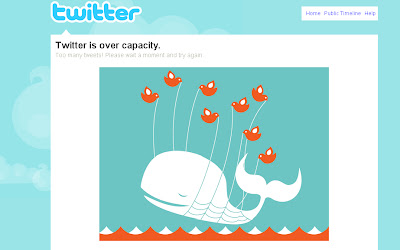
Twitter had quickly become a rising star on the web with millions of users. In the April time frame their traffic spiked to a level beyond what their underlying architecture could handle. Now Twitter is the joke of the town and are victims of daily outages and performance issues. What we found out is that behind the scenes the baby is ugly. Twitter recently responded to some questions from Techcrunch and revealed more information about their "architecture" then any sane person would offer. Here is a summary of what I learned:
- Use one database for writes (because "replication of MySQL is no easy task")
- Limited scalability -3 physical database machines "POWERING ALL OF TWITTER"
- Human Intervention required - "There's a lot of necessary handholding and tweaking "
- They plan to grow operations, rather then fix the handholding
- Tightly coupled - massive traffic on one part affects all
- Many design flaws - "Everything from faulty process, environment, configuration, and just plain load"
But Twitter is not the only startup having issues. It is becoming common for me to experience crashes and outages in my daily routine of using various new web sites and services. There have been days that I have seen four sites down at the same time. It is getting so common that I started creating a collection of screen shots.
Technorati has been struggling recently with a surge in web traffic. Countless other startups have flashed their cute crash messages on my screen. To me, the joke is on them. It's no wonder that the corporate architects of the world (me included) get a little annoyed when the media and talking heads start touting Web 2.0 and Mashups as the silver bullet for enterprises. Many have said that we should skip SOA because it is hard and time consuming and instead go the WOA route. I think Web 2.0, Mashups, and WOA are all great technologies, but when they are applied to an architecture that does not scale or do not follow some form of governance to assure some level of QoS, then you will likely need to design a cute outage web page to entertain your users as your team scrambles to bring the system back on line.
Here is one that I have created for any new startup out there.

I had a few really attractive jobs show up in my inbox this week which I posted on my IT Job Board. Feel free to share these with your friends and colleagues:
- CTO - Web 3.0 company - remote
- CIO - Saas company in Ohio
- Software Architect - Phillips Medical in Boca Raton, FL
- Business Analyst - Oklahoma City, OK
- Oracle Portal Admin - 6 month contract, Rochester, NY
- Analyst - Entry level, Jacksonville, FL


I have been experimenting with Jott lately. Jott is a service that let's you translate voice messages to many different services like SMS text messages, Twitter messages, and blog posts. I just tested the Jott to Blog functionality. Since Jott messages cannot exceed 30 seconds, I refer to this as "Micro Podcasting". Is this useful? The jury is still out, but it is simple to do.
So below is a transcript of my voice message. You can see that Jott butchered my message. Luckily, it creates a blog post in draft mode which gives the blog author a chance to touch it up. For the sake of showing how this works, I am leaving the transcript unedited. At the end of the micro podcast you can click on the link to listen to the actual message. Enjoy!
This is my first test of what I am calling micro podcasting, what that is it is using jott we have short podcast and it will go right in your phone into your ____ account, it's pretty cool stuff. I checked this out last night and sent my first twitt using jott and in twitter there is a turn called micro blogging and that sending out short information ___ to blogs, here I am doing micro podcasting leaving out short messages, voice messages, so that's it for today my first micro podcast. listen
Powered by Jott
I have created many Jott's and most of them translate very well. For some reason this Jott did not translate well. The key is to speak clearly and slow enough so that Jott can create a clean translation. With all that aside, it is pretty cool that I can speak into a phone and create a blog post that has both a transcript of my voice mail and a link to the actual voice message.


I am going to regret ever trying this but I was talking with my friend Dennis Stevenson on Google Talk tonight and we were admiring how social networking has opened so many doors for us from a networking standpoint. In our conversation I mentioned half jokingly that all we need is to be able to send Tweets by phone. Then I remember trying out Jott several months ago which is a service that converts voice to SMS text messages from any phone. So I figured that I could hack up something to intercept the SMS text message to send to my blog which automatically feeds new blog posts to my twitter page.
When I went to Jott, which I had written off as a tool that I had no use for, I was pleasantly surprised to find that the smart folks at Jott where one step ahead of me. They already had Jott integrated with Twitter. I simply called the Jott number, said Twitter, and then spoke a short message. Within a few minutes I had a Tweet on Twitter with a tinyurl link to my message.
Then I found that Jott is integrated with Blogger, Wordpress, Google Calendar, and many others. Imagine being on the road and you remember that you have an appointment at 2pm the next day. You can call the Jott number (mine is voice activated) and tell Jott to call Google Calendar. Then simply speak into the phone to set up your appointment in your Google Calendar and you are done.
I probably will now be responsible for many car accidents for sharing this. But seriously, the possibilities with Jott are endless!


